Category Archives: The Writing Life
Remember why you write
There’s a lot of talk online these days about the business of writing — blockbuster contracts, movie tie-ins, the financial benefits of self-publishing, Kickstarters, etc. I’m certainly guilty of it myself. Unfortunately, the main reasons we write — to tell good stories, to create and to reach out to other people — often get lost in all the arguments about money. It’s the way of the world.
Sometimes, though, you get a nice reminder about why you’re doing this writing thing in the first place. My second novel, The Warhol Gang, came out in 2010. It got lovely reviews but it didn’t make me rich, and it’s kind of hard to find these days. I still like it but I haven’t thought of it in a while. I’m busy writing new books, after all. Every writer knows new books consume all your waking thoughts and even some of your sleeping ones.
Yesterday, three people mentioned The Warhol Gang to me in messages. They didn’t know one another, and it wasn’t synchronized or planned. It was just three different people who saw something in the world that reminded them of The Warhol Gang and they thought enough about it to let me know.
That is worth much more than money to me.
To write a book that stays with people, that remains alive in their memory long after they put down the book, that is what every writer strives for, I think.
I’ve taken to sending messages of thanks to writers who have made a difference to me, as I want them to know their works have been appreciated and live on with me. I also want to thank all of you, my readers, for being the people who like the sort of stories I tell. The world needs more of you.
Sometimes, it’s nice to be reminded of why you write.
Kickstarting your writing career
Every now and then, someone asks me for advice on how to get published. To which I usually respond, “If I understood how the publishing business works, I’d be making a lot more money than I am now….”
The one piece of advice I do always offer, though, is to consider self-publishing. It was once frowned upon, but it’s now an increasingly viable way for writers to get their work out there — these days it’s often called “indie publishing.” Many writers have found it to be more profitable and more immediate than traditional publishing, where it can take years just to get a rejection. My good friend Kate Tremills decided to self-publish her first novel, Messenger, because she didn’t want to play the waiting game of tradpub and it worked out well for her. She cracked the Kindle top 100 list and at one point she was ranked higher than George R.R. Martin. Others prefer the creative control that self-publishing offers. And it’s a great way to keep your backlist in print — I self-pubbed my first book, Please, when the rights reverted back to me. It continues to sell although it hasn’t been in a bookstore in years. Just head over to the blogs of Joe Konrath or Hugh Howey to read more on the indie revolution.
And sometimes writers self-publish because it seems to be the only way to get their work out there. Earlier this week, Canadian spoken word poet Shane Koyczan launched a Kickstarter for his new poetry book, saying publishers more or less don’t even bother with poetry anymore. He was asking for $15,000 — a sizeable advance for a book of poetry. He’s raised twice that in only two days — $30,000. That’s about six times the average advance a publisher pays for a book of fiction in Canada. I wrote about the Koyczan Kickstarter over at The Province.
I’m not saying you should give up on publishers and move straight to self-publishing. But you should definitely consider it as an option. All the other authors are.
A dream of a novel
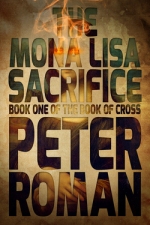
A number of people have asked where I got the idea for The Mona Lisa Sacrifice. It’s a bit, um, out there, after all.
It has its origins in a poem I read in my university days: “The Dream of the Rood.” I studied it in an Old English and medieval literature class taught by Nicholas Watson when he was still at the University of Western Ontario, where I earned my BA and Master’s degrees. I started a PhD at another university but never finished it. That’s another story….
Part of the poem tells the story of Christ’s crucifixion as seen by the cross itself. It was an interesting POV, and the poem stuck with me, in the way that random bits of culture and history can. Years later, I started thinking about the poem again and the idea of the cross as the body of Christ itself suddenly came to me. And that’s where the book began.
Another shred of cultural shrapnel, Keats’s “This Living Hand,” also made its way into The Mona Lisa Sacrifice. As did the Gaudi church that figures prominently in the book’s opening scenes — and which inspired my own pilgrimage to Barcelona. (Thanks, Robert Barsky!) There are no doubt others, of course, but these are big ones for me.
So if you want to get ideas for a book, get out there and live life. And, of course, read read read and read some more.
Here’s a link to the full text of Dream of the Rood, if you’re interested.
An interview with The Danforth Review
The Danforth Review has always been one of my favourite places to hang out online, so I was delighted when host Michael Bryson asked to interview me about my new novel, The Mona Lisa Sacrifice. Click the link to discover how MLS is like Don Quixote, why I’d cast Seth Rogen in the movie and what I did with the Rob Ford video.
On Spec — live!
Here’s a little video showing the inner workings of On Spec, where a few of my stories have appeared over the years.
"I’d like to go out of this world having brought as many good things into it as I can."
Here’s an interview I did with the Canadian Public Relations Society about how I balance my life as both a writer and a newspaper editor. It’s all about the coffee….
I’ve written plenty of books articles or columns that have come from my contacts in the writing community. And news stories have definitely led to fictional stories for me. For instance, my last published novel, The Warhol Gang, came into being after I read a couple of different articles, one about neuromarketing and one about a man who kept pretending to be an emergency responder at accident scenes. The two met up in my mind and mutated into a novel. So the two fields are a pretty combination for me.
What I'm backing: The Sword and Mythos anthology

If you’ve been following me at all, you know I’m a big fan of the Innsmouth Free Press — and not just because they published one of my stories. I love everything they’re doing with this journal, and I love that they’re pushing harder into the unnatural realm of books. The latest project is The Sword and Mythos anthology, which they’re raising funds for via Indiegogo. I’ve backed them and you should to if you care about literary supernatural fiction, especially that of a Lovecraftian bent. But if you really want a treat, help them reach $2,000 in funding by this Friday and you’ll receive a Lovecraft story by editor Silvia Moreno-Garcia called “The Atomic Flesh Cafe,” about “a letter-writing housewife in 1960s Mexico City. And Nyarlathotep.”
Come on. What more do you need than that?
Roll up the rim to write
Why did you choose to go the indie publishing route rather than stick to the traditional publishing route?
Social networking has put the steering wheel firmly in the hands of individual artists. It took me several years of being on Facebook before I realized that I was sitting in the driver’s seat of my own career as a writer. I’m using this funding campaign to help turn the key in the ignition.
ChiZine bundles free ebook with paperback purchase
I’ve been saying for a while now that if publishers want to keep selling print books they should bundle ebook versions with them, be it a DVD with epub files in the book or, more practically, a code that can be used to download the book. This could be difficult to carry out in a bookstore — the code or DVD would have to be securely sealed in the book somehow to prevent theft of the information, or stored separately from the book. Say, behind the counter. But it’s pretty easy for publishers to do from their own website. Now ChiZine has announced they’re going to do just that. Here’s their release (and note the 30% discount more than covers the cost of shipping for print books):
CZP Offers Free eBook with Trade Paperback Purchases
Starting now, you will also receive the ebook for free when you order trade paperbacks via the CZP site. As always, we’re offering a 30% discount off the cover price of all trade paperbacks. Once you complete your order, you’ll have instant access to the ebook in EPUB, MOBI and PDF formats.
This might be the first publisher I start buying direct from.




 peter darbyshire