Category Archives: The Writing Life
The Write Life: Research but don’t research too much
Almost every novel or story requires some amount of research or lived experience on the part of the writer. The closer it is to our world, the more this becomes important. But even fantasy novels typically involve research for sword fighting techniques if nothing else. And if you have lived experience of sword fighting, well, you’ve led a more interesting life than me.
Some novels are all about the research. I once took a class in university on the modern mystery novel where the prof theorized that a major appeal of the mystery genre was writers researching the hell out of a subject and putting it in a book — forensics, birding, rare coins, etc. It was one of the better theories I encountered in university.
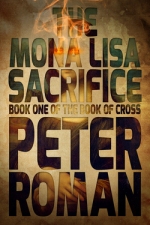
Research is critically important if you want to get a detail right or even just ensure the setting is accurate. For instance, I set part of The Mona Lisa Sacrifice in the Great Depression and I needed to get it right because the reader has to believe the world of The Mona Lisa Sacrifice is our world or the whole story falls apart. If the scenes set in the Great Depression era read as false, then the reader isn’t going to believe the parts of the book that feature angels moving among us in our world or faerie hiding out in abandoned pubs.
And in an age where everyone has unlimited information a phone away, you simply can’t bluff as a writer anymore or hope no one will notice an inaccuracy because it’s such an obscure detail. This actually came up when I was editing The Mona Lisa Sacrifice for publication with Wolsak and Wynn. The editor pointed out something I had gotten wrong in a scene set at the British Library. When I’d originally written it, I’d been relying on my memory of a visit there. But now there are video walkthroughs of the place available on the Internet. Which made it easy enough to fix that erroneous detail.
So if you need the reader to believe your world, then make sure you research the things that matter.
At the same time, don’t research too much. Sure, this may sound contradictory, but I contain multitudes and all that. (It’s Whitman – research it.)
The danger of research is that it can get in the way of creativity. A writer can research the subject so much that it kills their interest in the story because all the details of reality fill their mind and don’t leave room for the story, or contradict it in some way. Or they just get tired of the whole thing and the story loses its magic for them.
The key thing to remember when researching for a work of fiction is the research should serve the story not the other way around. Get the details you need right to make the story work and don’t worry about the rest.
Of course, you can always take liberty with facts and change the details to suit your story. We’ve all seen author’s notes that flag they have altered history to make a more compelling story. Just make sure you do flag it, or readers may think you haven’t done your research.
Related
- The Write Life: You need a second brain
- The Write Life: Make your desk a happy space
- The Write Life: You can’t do it alone
- The Write Life: Support your community
- The Write Life: Plotting or pantsing?
- The Write Life: How’s your focus?
- The Write Life: Write wonder
- The Write Life: What kind of book is this?
- The Write Life: Why use word trackers?
The Write Life: Why use word trackers?
If you’re not using a word tracker when you write, you should be. Word trackers are simple yet incredibly useful tools that should be an integral part of every writing process.
Accountability
Word trackers help you hit targets like daily word counts (or weekly or monthly, etc.) This gives you something to work toward, which in turn keeps you accountable and more likely to sit/stand at your desk and write until you’ve hit your goal.
Consistency
Accountability can lead to consistency, which is one of the most important factors in finishing a project. When you know you’re hitting a thousand words a day or whatever your goal is, you’re most likely to have a sense of progress, which in turn is more likely to keep bringing you back to write more.
Patterns
Word trackers can help you identify the times of day you may be most or least productive. Everyday distractions and stresses can sometimes be invisible. Using a word tracker can make the patterns visible.
Milestones
Word trackers can help you break large projects down into manageable milestones. For instance, it’s much easier to approach a project when you’re working toward writing 10,000 words in a month rather than writing 100,000 words by deadline X.
Word trackers can also help with a project’s internal milestones, such as act structure. If you know you want the first act of a book to break into the second act at 20,000 words, you can build toward that properly when using a word tracker.
Momentum
Word trackers can help you build momentum when writing. If you set yourself a modest daily goal, every time you surpass that goal it gives you a bit of creative energy.
Similarly, reaching certain points such as the halfway mark can also give you a creative boost and generate more motivation and momentum.
Accomplishment
The hardest part of a project is usually the beginning, when nothing is yet written. The more you keep track of what you have accomplished by using a word tracker, the greater the sense of achievement you have. That in turn transforms into the desire to create more.
Word trackers are about reaching goals, yes. But they are also about highlighting your achievements to yourself and generating more creative desire and momentum.
Different types of word trackers
There are as many types of word trackers as there are books. Some are simple number trackers, while others provide visual progress markers in the form of charts, percentages, etc.
I’ve used a range of apps for different projects: Word Keeper, TrackBear, Notion and more. If none of those work for you then you can make your own word tracker. Create a spreadsheet, use post-it notes on your wall, tattoo it on your arm. Whatever helps you finish that work and bring it into the world.
Related
- The Write Life: You need a second brain
- The Write Life: Make your desk a happy space
- The Write Life: You can’t do it alone
- The Write Life: Support your community
- The Write Life: Plotting or pantsing?
- The Write Life: How’s your focus?
- The Write Life: Write wonder
- The Write Life: What kind of book is this?
The Write Life: What kind of book is this?
Before you begin writing your book, it’s important to know what kind of book you’re writing. Is it horror, sci-fi, fantasy, romantasy, literary fiction, etc.?
It’s important to know the nature of your book to help you and others understand how it fits into genre categories and thus the marketplace. If you care about such things, that is. No judgement from me if you don’t, as I often don’t think of the marketplace at all. But trust me when I say your life as a writer will be easier if you do consider the marketplace before you start writing.
If you don’t like writing to genre categories, you can always mix things up a little and create a hybrid. Romantasy came out of the fantasy and romance genres, after all, and it’s the biggest thing in publishing right now — maybe even ever.
Once you have the basic genre established in your mind, you need to consider the book’s form, its defining structural or stylistic feature. Here’s a quick overview of some of the more popular ones and more or less contemporary examples.
Quest
A hero or group of heroes pursue a specific goal, overcoming obstacles to achieve the goal.
- Lord of the Rings by JRR Tolkien
Picaresque
A roguish, lower-class protagonist moves through society in an episodic manner.
- The Blacktongue Thief by Christopher Buehlman
Epistolary
A tale told through letters, diary entries and other documents.
- This Is How You Lose the Time War by Amal El-Mohtar and Max Gladstone
Bildungsroman
A coming of age tale, often with moral development.
- His Dark Materials series by Philip Pullman
Kunstlerroman
A chronicle of the development of an artist.
- A Portrait of the Artist as a Young Man by James Joyce
Unreliable Narrator
A tale told from the POV of a character that cannot be trusted.
- Gone Girl by Gillian Flynn
Story Within a Story
A tale that is often about storytelling itself because of its very nature.
- Invisible Cities by Italo Calvino
Historical Fiction
A tale set in a carefully researched past, often meant to highlight issues in the present day.
- Libra by Don De Lillo
Gothic
A story set in an atmosphere of dread and decay with supernatural overtones.
- Crucible of Chaos by Sebastien de Castell
Dystopia
An imagined society used to critique the present or at least present trends.
- The Handmaid’s Tale by Margaret Atwood
Metafiction
A tale that draws attention to its own fictionality, often to mediate on creativity but sometimes to critique social or cultural issues.
- If on a Winter’s Night a Traveller by Italo Calvino
Satire
A comic tale, often dark, meant to mock or critique some element of society or current trends.
- Catch-22 by Joseph Heller
There are many more forms of novel than this, of course. And writers often combine different forms and structures to create innovative new works and entirely new structures. But it’s important to have an understanding of the classics before you set out so you can have a vision for your own work.
Remember, you are entering a literary conversation of the ages! Make sure you understand the language first.
Related
We tell ourselves stories to imagine a different world
Have you been turning away from the world of late and finding sanctuary in books or other forms of art? If so, you’re hardly alone.
The publishing world has seen a boom in the fantasy genre, as readers seek escape from the present times where we find ourselves increasingly powerless before tech autocrats and self-serving politicians who want to destroy the existing order and rob us all of the meagre lives and agency it has brought us. At least in fantasy novels individuals have a chance of changing the world and good can actually win out over evil. Escapism yes, but perhaps inspirational escapism.
I’ve been particularly drawn to urban fantasy because of the way it transforms the existing world into one with magic and mystery. Urban fantasy re-injects wonder into our world — and we are seriously lacking in wonder at the present moment. We need something that can transcend this miserable existence but also change it, in the imagination if nowhere else. The magic of urban fantasy promises the re-enchantment of the mundane.
It’s why I focused on the act of creativity as magical and mysterious in my most recent book, The Wonder Lands War. Books become portals to other realms in The Wonder Lands War, with Lewis Carroll’s Wonderland tales acting as gateways into the imagination itself (among other places). Libraries are secret bastions of power while librarians are not so secret magicians. And paintings, sculptures and books offer keys to immortality and escaping death.
Of course, I’m not the only one who sees something magical in creativity.
The poet William Blake saw the imagination as the remnants of divinity in our soul, a sort of personal connection to a spiritual realm. The more contemporary poet Christian Wiman says in He Held Radical Light that “there is a persistent, insistent mystery at the center of our existence, which art both derives from and sustains.”
And musician, writer and 21st century theologian of sorts Nick Cave discusses a similar conjunction of creativity and transcendent mystery in Faith, Hope and Carnage with journalist Sean O’Hagan, where he says “You have to operate, at least some of the time, in the world of mystery, beneath that great and terrifying cloud of artistic unknowing.” To Cave, the creative impulse is a spectral or perhaps transcendent force that calls creators to follow it rather than the other way around.
These acts of the imagination manifest themselves in the real world in the form of artistic creations and provide knowledge and comfort. There is a reason so many of us seek solace in bookstores and libraries, in art galleries and museums. One of my favourite literary moments is in Roger Zelazny’s Nine Princes in Amber, where the protagonist Corwin reflects on the magical power of libraries, where he feels “comfortable and secure to have walls of words, beautiful and wise, all around me. I always feel better when I can see that there is something to hold back the shadows.”
The reference to shadows takes on extra resonance in the Amber books given they form sort of a multiverse series with different realities being shadows of the one true realm, Amber, which was carved out of the chaos through an act of creation. Corwin’s father created the Pattern, a magical shape that gives order to Amber and thus existence, but the farther you get away from this act of creation, the more threatening the shadows become — until eventually you reach the Courts of Chaos.
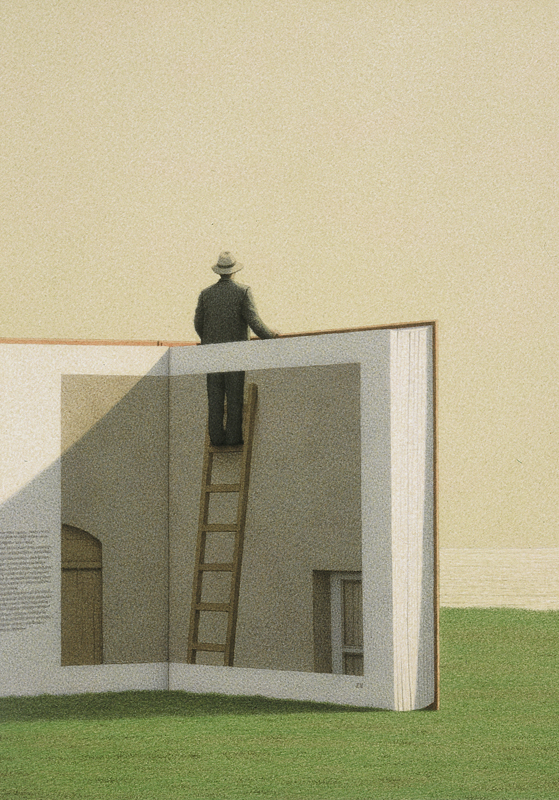
Similarly, the paintings of Quint Buchholz see the world of the imagination as real as our own, often using books as vehicles to move between these realms – to suggest they are both equally as real.
And are they not?
Umberto Eco argues creativity is the foundation of our very civilization, with books being the building blocks of our world.
“Literature creates a sense of identity and community,” he says in On Literature. “We might also think of what Greek civilization would have been like without Homer, German identity without Luther’s translation of the Bible, the Russian language without Pushkin, or Indian civilization without its foundation epics.”
The real world is made up of a history of acts of the imagination then. “A text is meant to be an experience of transformation for its reader,” Eco says in The Name of the Rose, but texts also transform the world itself.
Is it any wonder then that literary characters often take on a life of their own in our world? See, for instance, Timothy Findley’s Headhunter, where Kurtz is freed from Joseph Conrad’s Heart of Darkness in Toronto. Or The Unlikely Escape of Uriah Heep by HG Parry, where someone is pulling literary characters from books and into our world.
I feel so strongly that some characters have developed their own life that I gave them just such a life in my Cross books, which are set in the modern world. Alice from the Wonderland tales, Frankenstein’s creature from Mary Shelley’s tale, Ahab from Melville’s Moby-Dick, Captain Nemo from Jules Verne’s 20,000 Leagues Under the Sea and more make appearances in the world we find ourselves in — and hopefully add a little more magic and wonder to our world.
“We tell ourselves stories in order to live,” Cave says.
We also tell ourselves stories in order to live in a different world.
Image: Man on a Ladder by Quint Buchholz
My Favourite Bit of The Wonder Lands War
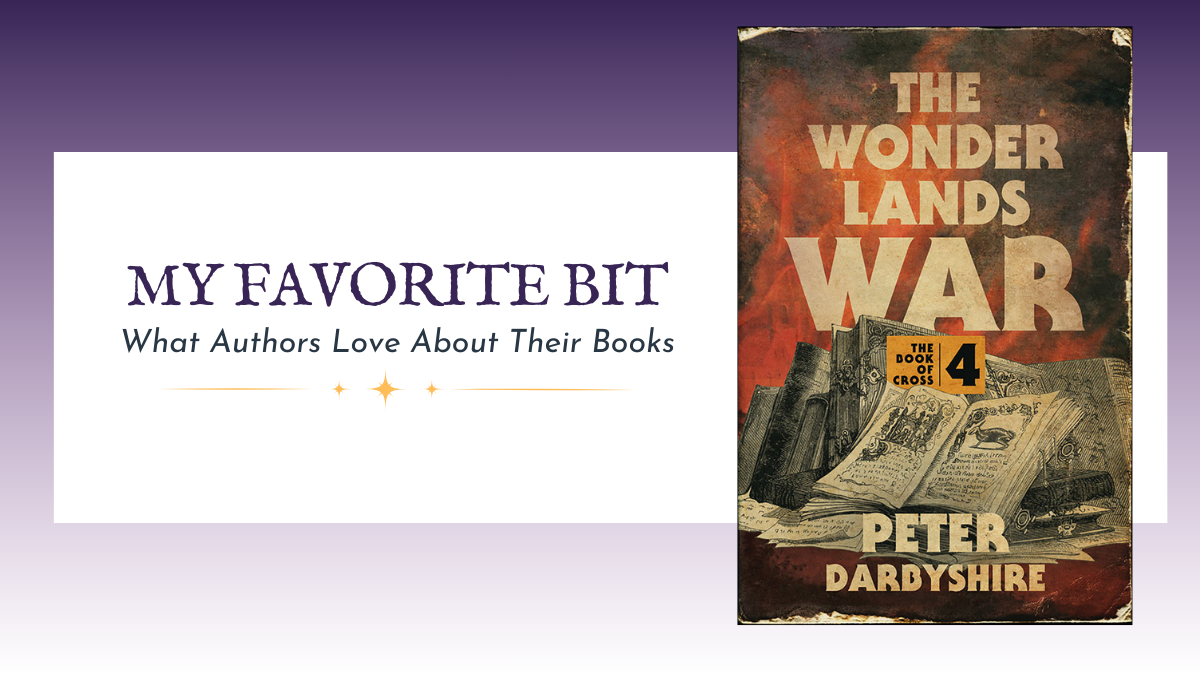
What if your favourite places from books, paintings and other works of art were real?
I’m over at Mary Robinette Kowal’s site talking about My Favourite Bit of The Wonder Lands War, which features the immortal rogue Cross trying to find the Wonder Lands — the faerie realm that inspired the Alice in Wonderland tales — so he can save Alice from a rogue group of angels.
“The Wonder Lands War is a descent into a literary rabbit hole, where I try to capture the spirit of the original Wonderland books and meld it with the Cross universe. While Cross’s quest takes him to many fascinating places — magical libraries with supernatural librarians, a Venetian island of murderous and undying priests, a secret tomb for an angel within the Vatican — my favourite place in the book is the Wonder Lands, which are more dangerous than their literary counterpart.”
The Write Life: Write wonder
Every writer hears the advice “write what you know” at some point or another because it’s useful advice. Writing what you know inserts authenticity into your work, to say nothing of confidence. It’s particularly valuable advice if you’re writing in a genre where people may be intrigued by what you know – a doctor writing medical thrillers, a forensics expert writing mysteries, a biologist writing sci-fi and so on.
Writing what you know can come with its own limitations, though. If you’re restricting your subject matter to your own experience or even just your own point of view, you’re shutting out most of the world from your work. Even worse, you’re closing down an endless universe of imagination.
Write what you know, sure. But above all, write wonder.
Write about the things that cause wonder in you. This will keep you interested in your work, which matters more than most writing advice acknowledges. Your exploration of ideas will make it more compelling to readers if it hooks your own imagination. You have to be curious about your own writing and enjoy its journey. If you’re not feeling wonder at the tale, then how can the reader?
You must also write to cause wonder in others. Write about those universal subjects that capture all our imaginations, the things that transform us and send each of us off on our own journeys. Make the reader think, make them experience. They don’t all have to experience the same things and perhaps it’s best they don’t. But make them feel something.
Remember that a book is not just a stand-alone object. It is part of a broader conversation of ideas, characters, worlds and experiences. When a reader finishes your book and something in it stays with them, that’s the book joining the ongoing conversation of all that’s ever been written. You’re not just making a product here. You’re adding your voice to something much larger than yourself.
Write what you know but don’t stop there.
Write into the unknown. Write the question you don’t know the answer to. Write the world you haven’t visited yet.
Write wonder.
Related
The Write Life: How’s your focus?
You have an idea for your new book or story, you’ve figured out the genre, you’ve created an outline, you’re sitting at your desk ready to go… now what?
Maybe make some coffee and respond to those emails so your mind is clear before you start typing? Or take one last scan of the news so you know whether your new work is completely out of touch or not? Or clean your home? Or or or….
Before you actually start writing, you need to create an environment where you can focus on the writing and nothing else. Actually, you’re going to need to create a few environments.
First, protect your physical space from distractions. Lock yourself in a room alone if you are able. Put a “do not disturb” or “ask someone else” sign on the door. I know a writer who puts a sign on her office door that simply says “no.” Close the blinds if the world outside is too distracting. Turn music off or on for the same reasons. Block time on your calendars so no one interrupts you. In short, make sure there is nothing in your physical world pulling you away from your writing world.
Next, find ways to prevent digital distractions. They are particularly challenging as most apps and services are designed to compete for your attention so you check in multiple times a day. This constant stimulation is kryptonite for your focus. Turn on your devices’ Do Not Disturb options and use website blockers if you can’t resist temptation. (No judgement – we’ve all been there.) Some writers I know only write on devices not connected to the Internet to manage this. Others use different methodologies such as the Pomodoro technique, where you use a timer to write for 25 minutes, take a short break, then write for another 25 minutes. There are lots of apps out there that will help break your addiction to other apps in this way.
Embrace digital minimalism. Audit your apps regularly and remove everything that doesn’t serve your goals and distracts you from writing. Too often we end up serving the apps rather than the other way around, so it’s good to check in on your relationships with your apps from time to time. Cal Newport has a pretty good book on this called Digital Minimalism that every writer should read.
Now that you’ve removed distractions as much as possible, try to write at the same time every day for the same amount of time. Write in the same place if that works for you, or change it up if you’re more the type that needs a bit of variety. A habit like this will reinforce itself over time and gradually become unconscious.
All of these actions are designed to get you into the flow state, where the writing just happens. It does take work and structure, though. Like meditation, this clarity of mind doesn’t come naturally but requires a lot of practice.
Save the “shallow work” for the end of the day or for scheduled breaks. (Cal Newport identifies a useful distinction between deep work such as writing and shallow work such as responding to emails, paying bills, etc. Check out his book Deep Work for more on this.)
End the workday with something that allows you to easily slip back into focus state the next day. For instance, end halfway through a chapter where you are excited to write the next scene. This will make it easier to sit down and start writing again.
Your focus is like a muscle. The more you regularly train it, the stronger it will get.
Now stop reading this and get back to writing.
Related
“Be the creative spark that lights up the world”
I’m over at On Creative Writing talking about pantsing vs. plotting, the editing process and why everyone’s voice matters.
Bonus: There’s a preview of the cover for my new book out in October.
The Write Life: Support your community
Now more than ever it’s time to support your community. It’s become clear that without active support, many of the communities we love and see ourselves as belonging to may wither and fade away. This is especially important for writers and other creators, whose communities are tenuous at the best of times.
How best to support your writing community?
Read, read, read. Read widely and deeply — and make an effort to read those writers who aren’t constantly in the spotlight. There are many fine writers whose works get overlooked because they are with smaller publishers that can’t afford a lot of marketing or who simply aren’t interested in self-promotion or social media. Go to the websites of smaller publishers in your country or writing/reading niche and see who they are publishing. You’d be surprised at how many writers you find who have fallen off your radar but you actually want to read. This is especially true if you live outside of the U.S. because, let’s face it, American publishing tends to dominate the cultural conversation. Hey, some of my favourite writers are American but I like a bit of variety!
Tell writers you like or appreciate their work. I can’t tell you how many times this has mattered to me when I’ve felt like giving up on a project and lighting my computer on fire. A well-timed social media post or email can mean the difference between a writer finishing their next work or not. We tend to work in isolation, after all, and the feedback we get tends to be spaced at very long and irregular intervals. Much like royalty payments! I can’t speak for other writers, but a generous comment here and there has meant as much to me as a positive review somewhere. I’ve even made some lasting friendships out of people reaching out to me!
Speaking of reviews, share the love for your favourite books. As fewer books are being reviewed in the media, personal recommendations matter more than ever. A review doesn’t have to be a carefully crafted BookTok video. It can be a few lines on your review platform of choice, or a simple photo post on your preferred social media platform. Don’t forget to tag the author to make their day and help them share your post! (But for the love of all the gods, don’t tag authors in negative reviews. That is not helpful!)
If you can’t leave a review, please consider leaving a rating. For better or worse, we live in an algorithmic world and ratings matter to a writer’s career. Every rating you leave on Goodreads, Amazon, Indigo, wherever actually does make a small difference to getting an author shown to potential readers, and it takes very little time to click on a star.
For what it’s worth, I think star ratings for books and other cultural works is madness. They’re not blenders (although my books have been called genre blenders!). I just give everything I read and like five stars because it’s all a matter of personal taste anyway. It’s the best I can do until someone comes up with a better system. Like maybe the number of times parts of a book have been highlighted and bookmarked….
Subscribe to the magazines that publish writing you like. This is a really simple one. If people don’t subscribe, then those magazines will cease to publish and there won’t be writing you like. It’s the same as buying books. Without a supportive community, there is no culture.
Most magazines can be found on Patreon these days, which makes it pretty easy to subscribe to them, and digital subscriptions are usually quite affordable. As a bonus feature, many magazines offer specialized communities to their subscribers in the form of Discord groups. So you’re getting twice the community for the price of one subscription!
Get out in person to events if you can. Go to the writers’ festivals, the reading series, the book launches, the conventions, and so on. If there aren’t in your area, then consider starting some. Join a writing group and use it for more than writing. (My writing group mostly plays games these days.) The same goes for book clubs. We’re social and physical creatures, and nothing builds community like presence. Most of my best and enduring friendships have been because of real-world events like this.
Once again, read, read, read!
The Write Life: You can’t do it alone
Writers are probably the most antisocial people around. After all, our ideal state is to be locked alone in a room all day, trying to convince imaginary people to do what we want them to do. Most days we’d rather read about other imaginary people than leave our homes to meet real people. If you’re a writer, you’re probably nodding in agreement at this point.
There is nothing more important to writers than community, though. In fact, I think building or joining a community is where the writing starts. I never would have become a published author if not for the university writing group I joined, which for the first time introduced me to editorial feedback, other perspectives on writing, revisions and writing to deadline. That writing group became some of my closest friends, and those friendships persist today even though we are scattered across the continent. (I swear they’re not all trying to avoid me.)
The value of finding like-minded people cannot be overstated. Did I say value? More like critical need. Without such a network, you are in a void when you start out, and you will be writing into the void. A community gives you an audience, gives you affirmation that what you are doing is worthwhile and necessary, gives you a path of development.
Of course, not everyone can find a local community. And there’s something to be said for joining online communities even if you do have a writing group that meets in person. Your writing community can never be too large. Or perhaps you need more than one community to fill all your needs. I contain multitudes and all that.
I have a local community in my area that has helped a great deal with improving my writing over the last few years. Hell, I likely wouldn’t have written anything without them. I was going through a hard time in my personal life, and writing would have been the last thing on my mind if not for my community. As it turned out, that writing group was what kept me sane and motivated during some crazy times. If not for the accountability of writing to hit the group’s deadlines, collaborating in some writing sprints, etc., I don’t know what would have happened.
We’ve mostly moved the group online to a dedicated Discord server but still meet in person once a month for games nights. And I’ve joined other groups to meet the needs they can’t fulfill — a different writing group for other projects, Codex and SFWA for writing and market chats, and a few private Patreon groups linked to magazines. All those communities help keep me immersed in a culture of inspiration and creation, which is half the battle right there when it comes to writing. And most of the battle when it comes to procrastination.
So what makes for a good community?
Make sure you find or create a community that actually helps you contribute to your development. That development can be different things at different stages of your life. It could simply be having readers and deadlines for accountability to keep you writing, or it could be beta readers to help polish your book for publication, or it could be agents who can connect you with markets. It could just be a group of writers talking different theories of writing. My writing group spent time studying Save the Cat, the hero’s journey and the heroine’s journey, and various Masterclasses.
Whatever it is that you need to become a better writer, you’ll find that a writing community will better help you achieve your goals. And hopefully keep you sane in the process! Well, as sane as a writer can be….