Category Archives: The Writing Life
The politics of piracy
I may have weighed in once or twice on this reddit thread about whether book piracy is OK or not. Spoiler: I don’t think it is.
The best way to buy my new book

I’ve had a number of people ask me the best way to buy my new book, The Dead Hamlets. Normally my response is to say buy it at your local bookstore or favourite online site. Unfortunately, while Chapters sells the book through its website, it isn’t carrying many copies of The Dead Hamlets in stores. (U.S. readers: Chapters is the national bookstore chain in Canada — sort of like a Barnes and Noble only with more pillows and picture frames. The book is available at Barnes and Noble stores.)
I’m not entirely certain why this has happened. Part of the problem is likely Chapters’ ongoing shift to a cultural lifestyle store, which means they’re carrying fewer books for a shorter amount of time. Small publishers like ChiZine are obviously going to get hurt by this. At the same time, ChiZine’s main distributor, HarperCollins, decided to get out of the distribution business in Canada right around the same time the book launched. I can’t help but think that The Dead Hamlets got lost in the shuffle. So the book got hit by a double whammy at the worst possible time. It’s almost like there’s a witch’s curse or something….
I’m not really blaming Chapters here. People are ordering more books online or simply giving up on print altogether and ordering ebooks. Unless you’re a bestseller or have bestseller potential, it’s becoming harder to get shelf space in bookstores. As for the distribution changeover, well, that’s the way the industry goes sometimes.
I am kind of crushed by this development, however — every author wants their new book in bookstores, after all. This is kind of the author’s life, though. Business happens.
So that gets to the question of how you should buy my book. A number of people have asked if I’m selling them directly at events. I am, and you’re welcome to buy a book from me in person. Seriously, if you see me walking down the street, just come at me with money in your fist. I will almost certainly stop to talk to you.
But I would prefer you didn’t buy the book directly from me. Instead, I would appreciate it if you buy The Dead Hamlets — or any of my other books — from a bookseller. Why? Well, it’s good for the cultural ecosystem and all that. So there’s my public service announcement of the day. But more importantly, it’s good for the author. If people order the book at Chapters bookstores or even order it online from the Chapters website, where it is available for sale, then maybe Chapters might think twice and stock more copies of it in stores.
Similarly, if people order it from Amazon or Kindle or whatever, that also helps me. Every sale on Amazon boosts my sales ranking, for instance, which helps more people to see the book. Plus, whenever someone buys a book through Amazon, the algorithms send that out through the system and populate other people’s recommendation lists with the book. So if you buy say, A Game of Thrones book and The Dead Hamlets, then The Dead Hamlets will show up for other people who go looking to buy A Game of Thrones book. Or something like that — the Amazon system can be a bit of a mystery sometime.
You can always buy it from your local indie bookstore, too. They’re often the ones with the best selection, and they need support in these times more than ever.
The point is buying a book from a retailer helps me way more than buying a book from me in person does. This will be especially important when it comes time to publish the third book in the Cross series.
Wherever and however you find The Dead Hamlets, I hope you enjoy it. If you do like it, please consider giving it a shoutout on social media or a review on Goodreads, etc. That sort of thing really does help book sales.
Thanks for reading!
The Dead Hamlets is featured on The Hook
I had the distinct pleasure of kicking off The Hook, a new guest post feature on Alex Shvartsman’s site. Alex is the author of Explaining Cthulhu to Grandma, which is perhaps the best title for a book ever. And it’s only $5 and change on Kindle! Why are you still reading this and not buying the book?
Anyway, Alex just launched The Hook, which lets writers explain why they opened their books the way they did. So click the link to find out why I began The Dead Hamlets on a dark and stormy night!
Thanks, Alex!
There’s a long tradition of dark and stormy nights in the theatre — lots of blackouts and thunder sound effects. The first stage directions of Macbeth, for instance, are “Thunder and lightning.” So I was hinting at the subject matter of my book in its opening lines. Shortly after that initial scene, I have Cross stumble into a theatre full of the dead — at which point things really get dark and stormy!
What I learned about writing from a church

Today I’m over at Kate Heartfield’s site as part of her Unlikely Influences on writing series. I reveal what I learned about writing from the Gaudi church. It’s one of my favourite places in the world and I can’t wait to go back there again.
The spirit of wild imagination and utter audacity of La Sagrada Familia, as well as its mashup of architectural traditions, gave me the imaginative framework for my book. The history of the church helped me to flesh out the character of Cross. The church has existed through several eras of history, just as he has. It’s been in a constant state of reinvention and evolution, just like he has. It combines different architectural styles, just as I do with literary styles in the book: noir, urban fantasy, historical fantasy, literary fiction, and probably some others I’ve forgotten.
Oh, my bookish ways
Hey, I’m interviewed over at My Bookish Ways. It’s one of my favourite sites, so I was pretty happy to wind up there. I talk about how my new novel came to be, reveal how I dealt with writing about Shakespeare (turn him into a wizard, of course!), and give shoutouts to some of my favourite writers. Bonus feature: If you live in the U.S., you can win a copy of The Dead Hamlets.
I asked myself what I would do if I was immortal, and that’s how Cross became a drunken, thieving, self-loathing liar with murderous tendencies who tries to do right by his friends.
The future of the Canada Council
A while back I wrote about the Canada Council planning a major overhaul of its funding processes. A lot of people were interested in it — OK, most of the creators in Canada seemed to be interested in it — so I contacted the Canada Council to find out more. I wound up having a fascinating conversation with Simon Brault, the head of the Canada Council about the changes. Read more about it over at The Province.
Brault says the future Canada Council will be “a sort of portal where artists create their own profiles explaining everything they do … Their job will be to explain to the Canada Council what they want to do, their artistic practice, and all of that, and our role will be to make sure that we serve them well in the context of very few programs … The intentions of the artists will be the driving force of the assessments and not a rigid compliance with a very small sub-program.”
If you’re reading this, you must be lost
I’m getting a lot of new readers at this blog recently thanks to the publication of my latest novel, The Dead Hamlets. So welcome and let me introduce myself. (If you’ve seen this already, scroll to the next post. I’m going to pin this to the top of the site for a few days.)
I’m Peter Roman, author of the Cross series of supernatural thrillers. I’m also Peter Darbyshire, author of the novels Please and The Warhol Gang. I’ll let you work out for yourself which one is the real me. (Spoiler: It’s a split personality kind of thing.)
If you’re new to the Cross books, here are the basics:
Cross is the poor soul who comes to life in the body Christ left behind when he shuffled off this mortal coil. Cross can use all the powers of Christ’s body, but there’s one catch: he needs heavenly grace to power the body. The only way he can get it is by killing the angels stranded on Earth and draining them of their grace. So, yes, we’re in anti-hero territory here. But Cross isn’t all bad. He’s loyal to his friends, which include the likes of gorgons and faerie, and even some literary characters such as Alice from the Alice in Wonderland tales. Needless to say, his friends get him in a lot of trouble.
 The series begins with The Mona Lisa Sacrifice, which follows Cross through the centuries as he tries to hunt down Judas. It turns out Judas is actually an ancient trickster god who’s made it his mission to ruin humanity — and to destroy everything Cross loves. Cross’s quest leads him into the middle of a holy war between the angels left on Earth, and that’s when things truly go to hell.
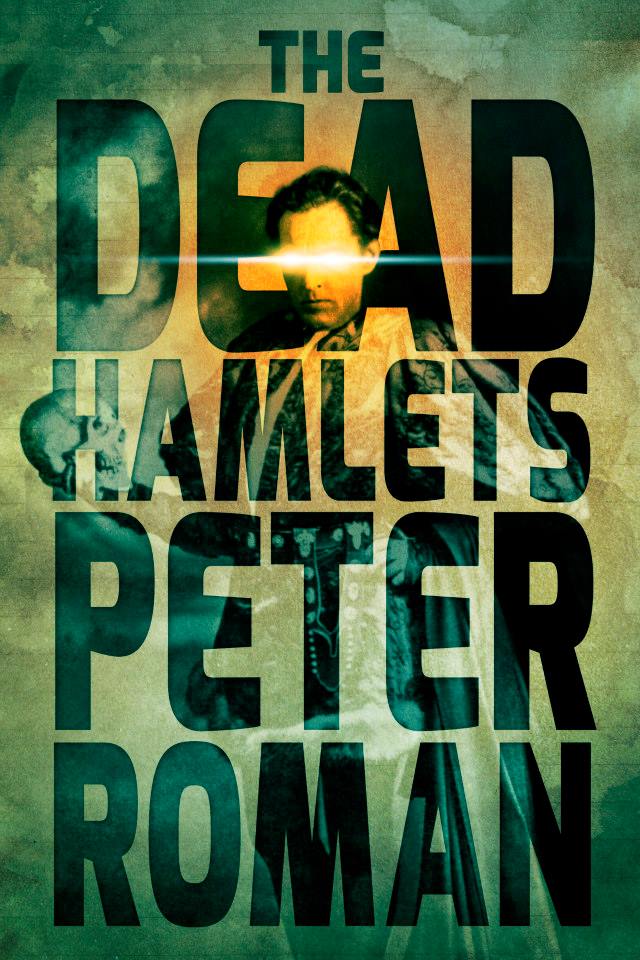 The second book in the series, The Dead Hamlets, checks in with Cross shortly after the events of The Mona Lisa Sacrifice. Cross has managed to fall under the spell of the faerie queen, one of his ancient enemies, and she puts him to work hunting down a ghost that is killing her subjects. But all is not as it seems. The murders lead Cross into a strange and eerie mystery populated with an eccentric and deadly cast of characters, including the Witches of Macbeth, the undead demon hunter Christopher Marlowe and a very supernatural and very deadly Shakespeare. When Cross discovers a startling secret about the origins of “Hamlet” itself, he finds himself trapped in a ghost story even he may not be able to escape alive!
The Cross books are published by ChiZine and have received rave reviews. The National Post called The Mona Lisa Sacrifice “a deliriously unhinged roller coaster of a novel, blending fantasy, history, horror and humour with the aplomb of an overfull blender, but all of it smarter than it, truly, has any right — or need — to be” and Publishers Weekly said “The novel never lets the reader pause for breath . . . fans of the genre will find one of its ultimate expressions here.” Early reviews of The Dead Hamlets have called it “A Rewarding, Witty, Hot Mess of Angel-Pummeling, Action and Noir Detective Fiction” and said it “resembles something written by Neil Gaiman at times with its somewhat mystical imagery and at other times it reads as a full-blown work of bizarro fiction.” I blush.
I’m currently editing the third Cross book and outlining the fourth. I’ll have more about those on the blog in the future.
 I’ve also written a couple of literary fiction novels as Peter Darbyshire. My first book, Please, won Canada’s national ReLit Award for best novel. Please chronicles the life of a young man who drifts through a hallucinatory urban world filled with celebrity wannabes, addictive relationships and jobs that demand he become someone else. Booklist said “Darbyshire plumbs the murky regions of the soul in a novel of dark brilliance,” Kirkus called it a “hilarious social satire of daily life among the young and nihilistic” in a starred review, and The Globe and Mail said it was “a consummate critique of all the creeping human weaknesses, counterfeit values and trend-driven desires that steadily erode our hopes for meaning and purpose.” I just thought I was writing about my own life. Go figure.
 My second novel, The Warhol Gang, is a black comedy for anyone who’s ever been trapped in an office job or lost in a mall. The narrator works for a neuromarketing company that scans his brain to see how he responds to imaginary products. Trapped in an increasingly unreal world, he starts hanging out at accident scenes to experience the most real things possible. He meets a group of counterculture activists who stage accidents for insurance fraud, and falls in love with one of them. When one of their incidents turns deadly, the media turns them into a terrorist gang. That’s when things get weird. The Globe and Mail called it “a violent, darkly comic satire of our media-saturated society” while Postmedia said it was “one of the finest, and most important, Canadian novels in recent memory.” My personal favourite is the review that said it was “Denis Johnson stomping Chuck Palahniuk into William Gibson while Kurt Vonnegut cheers him on.”
I’ve also published some short stories, if that’s more your thing. Hey, I don’t judge.
I have an irregular newsletter that I send out through the TinyLetter service. You can sign up here.
I can be found at the usual social media hangouts online. The links are at the top of the page.
Thanks for reading. I hope you’ll stick around!
I hate you! Wait, why are you getting so upset?
I lost some of my precious writing hours today because I got pulled in by a thread on reddit about when to tell writers you don’t like their work. My first thought was “never,” but then I realized I have taken the odd positive thing out a negative comment. So I wrote the following in response:
I’ll acknowledge that I’ve taken readers’ criticism to heart and changed things about my writing because of it. But so much depends on the nature of that criticism. There’s a huge difference between “This book had a magic sword and magic swords are stupid. ONE STAR!” and “I didn’t really understand how that rib from the dead god became a magic sword, so I had trouble believing any of the scenes with that sword.” The first comment just kind of ruins my day. The second makes me pause and think about what I wrote. (“Ah damn it, I forgot to write the scene with the dragon blacksmith! Better get that in the sequel.”)
Receiving a message like the creator of HE did would be nothing but hurtful. I mean, that’s the direction Watson wants to be taking with his comic. I wouldn’t respond like he did — I’d probably reply with a “sorry to hear that but thanks for writing” or ignore it if I were having a really bad day — but there’s no way that doesn’t hurt. It makes your day when someone tells you they like your work. But it can also wreck your day when someone goes out of their way to tell you they don’t like what you do.
I really appreciate social media for the way it connects me with readers. Those connections really make a difference to me, and they keep me writing some days when I’m down on myself. But it’s a double-edged sword, etc. A writer I know recently had someone tweet a negative review of his book to him several times in a week — “Hey, just in case you didn’t see this yesterday…” Nothing good comes out of that.
If I find something I love, I let the creator know. If I don’t love it, I spend my time finding something else to love.
There’s a lot more I could say on the subject, but I’ll have to leave it at that for the moment. I’ve got a book to finish!
The Dead Hamlets are alive!

It’s alive! My new Cross novel, The Dead Hamlets, is shipping. ChiZine wasn’t just pranking me when they said they’d publish it!
I’ll have more details about launches, blog tours, reviews and so forth soon. But right now I’m just going to crack these open and breathe deep of that new book smell.
And then get back to working on the third Cross book.
It’s alive!
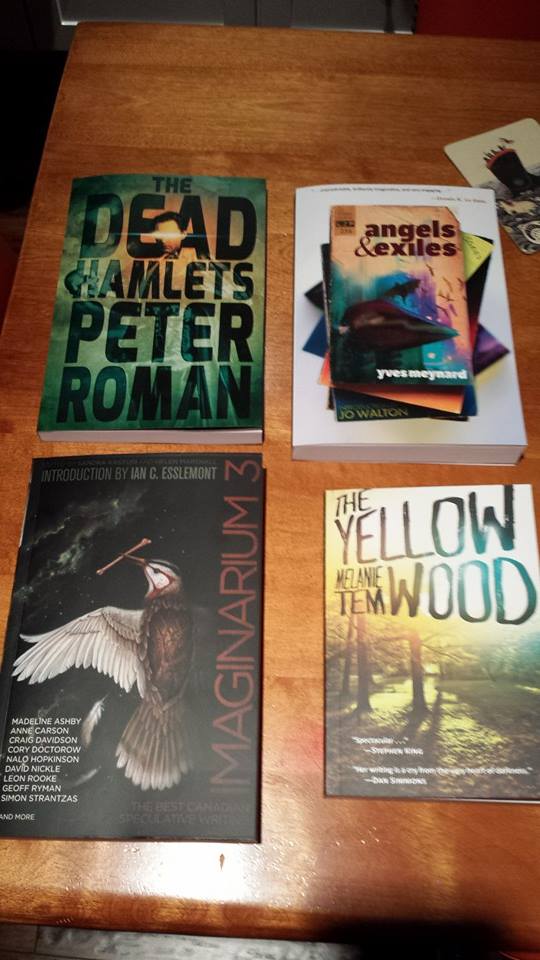
My publisher teases me by posting a photo of my new novel, The Dead Hamlets, partying somewhere in Toronto with new friends, in no hurry to find its way home to me. Wicked, wicked publisher.




 peter darbyshire