Blog Archives
How D&D made me the writer I am
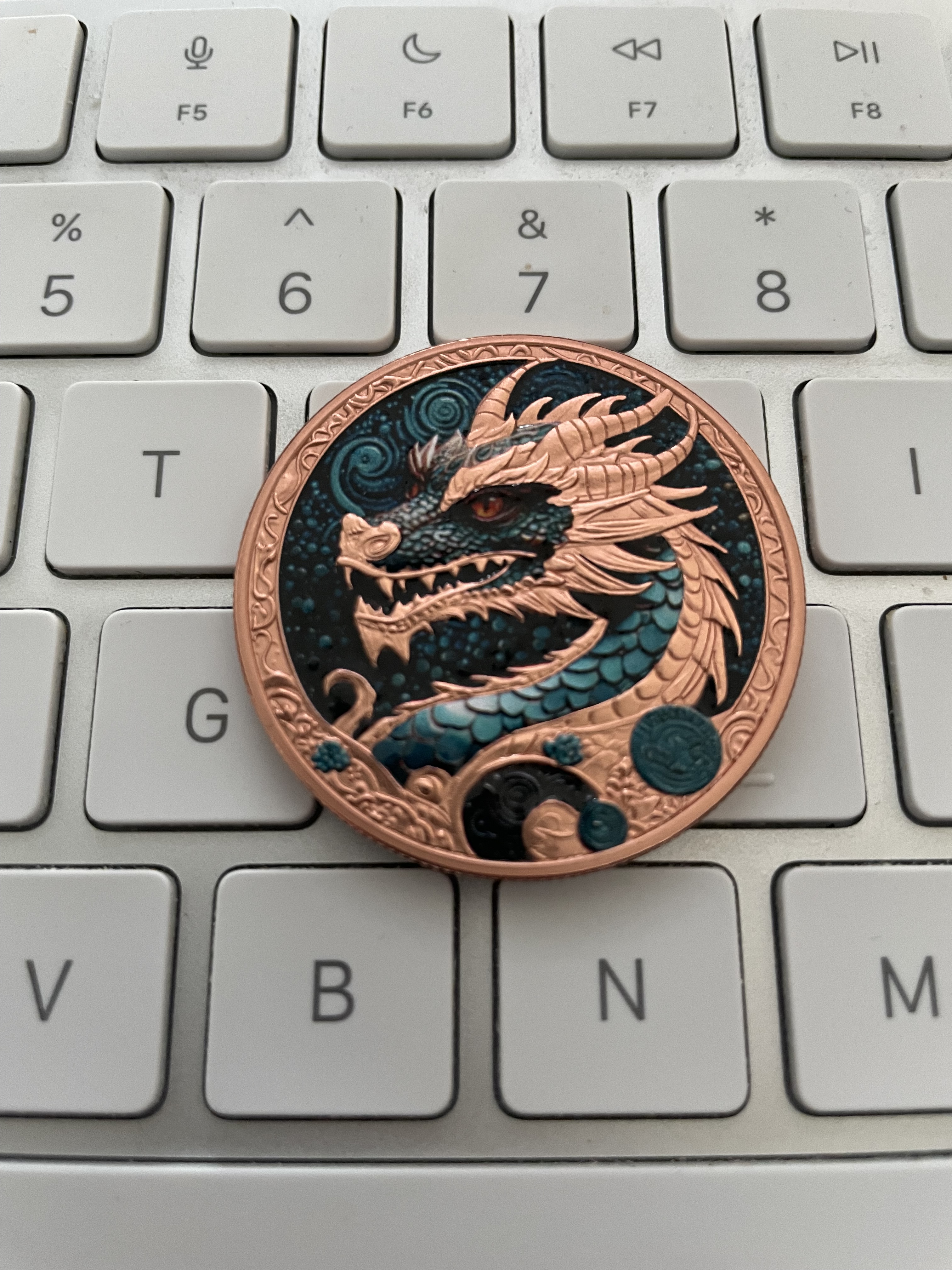
Roll a d20 for a creativity check.
Whenever I do interviews, the discussion often turns to Dungeons and Dragons. What sort of influence has D&D had on my writing? I suspect my answer to that is the same as many other authors: I wouldn’t be the writer I am without D&D.
I started writing around the same time I started playing D&D back in elementary school. (Basic rules!) I can no longer remember which came first, D&D or my writing, but it doesn’t matter. They are both equally important in the development of the imagination and those paths that led me to become a writer.
I’ve mainly been a GM (or DM if you’re old school), which means you’re dreaming up other worlds for the players to inhabit. More importantly, you’re dreaming up a compelling story for them. So there are a number of things you have to think about when running the adventure.
Worldbuilding
GMs and writers both need to create interesting worlds with enough detail to catch the imagination of the players/readers without bogging them down in unnecessary detail. Guiding players through countless worlds in D&D sessions has taught me what sort of details matter and what don’t and how to shape worlds to reflect the mood and atmosphere I want.
For instance, if I’m creating a D&D adventure where my players explore a set of ancient ruins in search of a lich that has been plaguing their realm, I’m going to populate those ruins with wraiths and other undead, crumbling tomes, accidental traps where floors of the ruins are collapsing, strange mists and haunting sounds, and so on.
That has taught me to do the same in my writing. My second Cross book, The Dead Hamlets, is about a Shakespearean ghost, and I worked hard to ensure every element of the book reflected that in some way. There are characters from the theatre, key moments take place on stages (real or fantastic), characters quote famous theatre lines, actual theatrical ghost legends are throughout and so on.
The Dead Hamlets is very different from the first Cross book, The Mona Lisa Sacrifice, where I really wanted to set up an alternate version of our contemporary world in which angels scheme behind the scenes and magic is hidden everywhere. In The Mona Lisa Sacrifice I researched different historical periods like the Great Depression and included references to Raymond Carver and modern and historical buildings like the Seattle library and the Gaudi church in Barcelona.
Of course, it’s worth mentioning that every GM and writer will have different priorities here. Some love worldbuilding that includes rational and comprehensive magic systems, genre rules and so forth, while others prefer things wilder and looser. I’m in the latter camp but it’s all a matter of preference.
Plot
Plot is just as important to D&D as it is to books and stories. I learned early that every game session needs to advance the story and the stakes for the players. If you’re just running around killing monsters and looting ruins, that gets old and boring very quickly. So each session sets up a goal for the players, an obstacle to that goal, and an outcome that advances the tale to the next session. It’s the same structure I use for chapters or even scenes. Goal, obstacle, resolution — the building blocks of any story.
(Of course I can’t help it if my players or characters don’t cooperate.)
Character development and emotional arcs
D&D players want their characters to grow and change — not only to become more powerful but to become fleshed out with dramatic stories and achievements. Players don’t simply want to do the same thing over and over. They want to evolve and have an emotional investment in this fictional character.
It’s the same thing for readers of fiction. They want to see the characters grow and develop — even if it doesn’t always end with positive outcomes. It’s become increasingly important to me to have characters that change, that develop over the course of the story in a way that readers recognize and care about.
This is something I had very much in mind in my fourth Cross novel, The Wonder Lands War. I could have simply written another tale of the immortal rogue Cross getting into trouble and saving the world, but I knew it was time for some big changes in Cross’s life after everything he had been through in the previous books. So the real focus of that book is about parts of his life and world ending, with his daughter’s death (second death, that is), the demise of the faerie court that have long been his companions and nemesis, and new relationships with the angels that he constantly seeks to kill. It’s a tale of how life happens to all of us, with inevitable change and some chapters coming to an end while others begin.
Collaborative storytelling
The idea of collaborative storytelling is particularly important for me, and it’s where D&D has really had an influence. I’m not one to play the game strictly by the rules or to follow adventure scripts like bibles. Instead, I tend to work with a general outline of ideas and continuously adapt it as the game evolves and my players do wonderful and crazy things. And sometimes wonderfully crazy things! I find the true magic of a D&D session lies in the moments that can’t be scripted ahead of time, when the players come up with something on the spot that even they hadn’t planned which changes the whole arc of the game. To me, the story we create together is the most important of the game, which is why I don’t mind altering the rules or the planned adventure to accommodate that story. (I’m definitely not a rules lawyer.)
Take, for instance, a recent campaign I ran where my players were intent on throwing a Saddle of the Cavalier upon every tough creature they encountered so they could ride it into battle. (A Saddle of the Cavalier prevents riders from being dismounted against their will.) They ended up battling what they thought was a beholder in a lich’s mansion and charmed then saddled it. However, they didn’t know that the beholder was actually a dream version of a Death Tyrant, which can’t be charmed. I could have played by the rules and had them fail the charm attempt. But in the moment I thought it was much more interesting to have them saddle up a Death Tyrant and ride it into combat against their enemies. I was right and we created an awesome and very memorable session together.
I try to keep that spirit of collaboration in mind in my own writing. I often present mini-scenarios in my books or stories that hint at tales not actually covered by the work at hand: interesting asides, nuggets of back story, that kind of thing. Take for instance, the idea I put out in The Mona Lisa Sacrifice of the Gaudi church being in fact a tomb meant to imprison something. Imprison what exactly? Well, that’s up to the reader to decide.
Some may consider these moments story threads that I’ve failed to tie together. But I see them as imagination prompts for the reader to create their own tales. Ideally, they’ll take the story hint I’ve inserted and create a whole other story with it. Now imagine that becoming a different story with each reader. So many tales that spring out of the original story! Just like so many different tales emerge out of D&D adventures. There’s a reason so many writers and D&D players!
I could go on about this forever, but it’s time for my D&D session!
(The coin in the image is a gift from the wonderful fantasy writer Sebastien de Castell, who also happens to be a D&D player.)
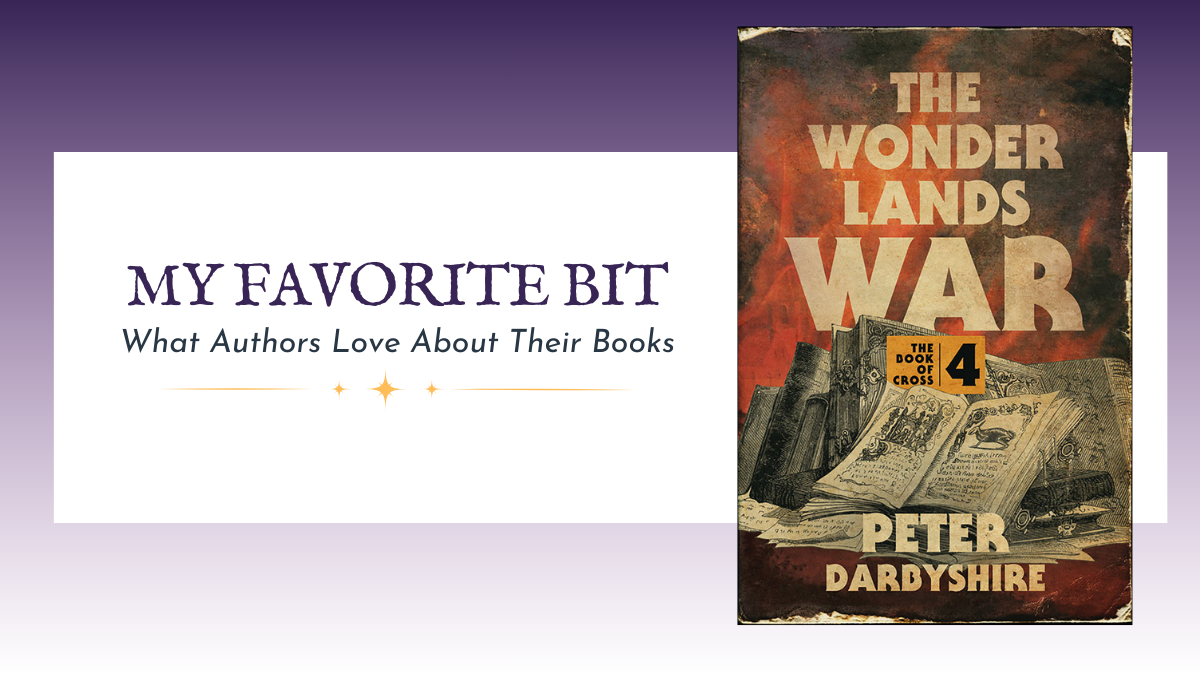
My Favourite Bit of The Wonder Lands War
What if your favourite places from books, paintings and other works of art were real?
I’m over at Mary Robinette Kowal’s site talking about My Favourite Bit of The Wonder Lands War, which features the immortal rogue Cross trying to find the Wonder Lands — the faerie realm that inspired the Alice in Wonderland tales — so he can save Alice from a rogue group of angels.
“The Wonder Lands War is a descent into a literary rabbit hole, where I try to capture the spirit of the original Wonderland books and meld it with the Cross universe. While Cross’s quest takes him to many fascinating places — magical libraries with supernatural librarians, a Venetian island of murderous and undying priests, a secret tomb for an angel within the Vatican — my favourite place in the book is the Wonder Lands, which are more dangerous than their literary counterpart.”
The Write Life: Write wonder
Every writer hears the advice “write what you know” at some point or another because it’s useful advice. Writing what you know inserts authenticity into your work, to say nothing of confidence. It’s particularly valuable advice if you’re writing in a genre where people may be intrigued by what you know – a doctor writing medical thrillers, a forensics expert writing mysteries, a biologist writing sci-fi and so on.
Writing what you know can come with its own limitations, though. If you’re restricting your subject matter to your own experience or even just your own point of view, you’re shutting out most of the world from your work. Even worse, you’re closing down an endless universe of imagination.
Write what you know, sure. But above all, write wonder.
Write about the things that cause wonder in you. This will keep you interested in your work, which matters more than most writing advice acknowledges. Your exploration of ideas will make it more compelling to readers if it hooks your own imagination. You have to be curious about your own writing and enjoy its journey. If you’re not feeling wonder at the tale, then how can the reader?
You must also write to cause wonder in others. Write about those universal subjects that capture all our imaginations, the things that transform us and send each of us off on our own journeys. Make the reader think, make them experience. They don’t all have to experience the same things and perhaps it’s best they don’t. But make them feel something.
Remember that a book is not just a stand-alone object. It is part of a broader conversation of ideas, characters, worlds and experiences. When a reader finishes your book and something in it stays with them, that’s the book joining the ongoing conversation of all that’s ever been written. You’re not just making a product here. You’re adding your voice to something much larger than yourself.
Write what you know but don’t stop there.
Write into the unknown. Write the question you don’t know the answer to. Write the world you haven’t visited yet.
Write wonder.
Related
“Be the creative spark that lights up the world”
I’m over at On Creative Writing talking about pantsing vs. plotting, the editing process and why everyone’s voice matters.
Bonus: There’s a preview of the cover for my new book out in October.
The Write Life: Support your community
Now more than ever it’s time to support your community. It’s become clear that without active support, many of the communities we love and see ourselves as belonging to may wither and fade away. This is especially important for writers and other creators, whose communities are tenuous at the best of times.
How best to support your writing community?
Read, read, read. Read widely and deeply — and make an effort to read those writers who aren’t constantly in the spotlight. There are many fine writers whose works get overlooked because they are with smaller publishers that can’t afford a lot of marketing or who simply aren’t interested in self-promotion or social media. Go to the websites of smaller publishers in your country or writing/reading niche and see who they are publishing. You’d be surprised at how many writers you find who have fallen off your radar but you actually want to read. This is especially true if you live outside of the U.S. because, let’s face it, American publishing tends to dominate the cultural conversation. Hey, some of my favourite writers are American but I like a bit of variety!
Tell writers you like or appreciate their work. I can’t tell you how many times this has mattered to me when I’ve felt like giving up on a project and lighting my computer on fire. A well-timed social media post or email can mean the difference between a writer finishing their next work or not. We tend to work in isolation, after all, and the feedback we get tends to be spaced at very long and irregular intervals. Much like royalty payments! I can’t speak for other writers, but a generous comment here and there has meant as much to me as a positive review somewhere. I’ve even made some lasting friendships out of people reaching out to me!
Speaking of reviews, share the love for your favourite books. As fewer books are being reviewed in the media, personal recommendations matter more than ever. A review doesn’t have to be a carefully crafted BookTok video. It can be a few lines on your review platform of choice, or a simple photo post on your preferred social media platform. Don’t forget to tag the author to make their day and help them share your post! (But for the love of all the gods, don’t tag authors in negative reviews. That is not helpful!)
If you can’t leave a review, please consider leaving a rating. For better or worse, we live in an algorithmic world and ratings matter to a writer’s career. Every rating you leave on Goodreads, Amazon, Indigo, wherever actually does make a small difference to getting an author shown to potential readers, and it takes very little time to click on a star.
For what it’s worth, I think star ratings for books and other cultural works is madness. They’re not blenders (although my books have been called genre blenders!). I just give everything I read and like five stars because it’s all a matter of personal taste anyway. It’s the best I can do until someone comes up with a better system. Like maybe the number of times parts of a book have been highlighted and bookmarked….
Subscribe to the magazines that publish writing you like. This is a really simple one. If people don’t subscribe, then those magazines will cease to publish and there won’t be writing you like. It’s the same as buying books. Without a supportive community, there is no culture.
Most magazines can be found on Patreon these days, which makes it pretty easy to subscribe to them, and digital subscriptions are usually quite affordable. As a bonus feature, many magazines offer specialized communities to their subscribers in the form of Discord groups. So you’re getting twice the community for the price of one subscription!
Get out in person to events if you can. Go to the writers’ festivals, the reading series, the book launches, the conventions, and so on. If there aren’t in your area, then consider starting some. Join a writing group and use it for more than writing. (My writing group mostly plays games these days.) The same goes for book clubs. We’re social and physical creatures, and nothing builds community like presence. Most of my best and enduring friendships have been because of real-world events like this.
Once again, read, read, read!
The Write Life: You can’t do it alone
Writers are probably the most antisocial people around. After all, our ideal state is to be locked alone in a room all day, trying to convince imaginary people to do what we want them to do. Most days we’d rather read about other imaginary people than leave our homes to meet real people. If you’re a writer, you’re probably nodding in agreement at this point.
There is nothing more important to writers than community, though. In fact, I think building or joining a community is where the writing starts. I never would have become a published author if not for the university writing group I joined, which for the first time introduced me to editorial feedback, other perspectives on writing, revisions and writing to deadline. That writing group became some of my closest friends, and those friendships persist today even though we are scattered across the continent. (I swear they’re not all trying to avoid me.)
The value of finding like-minded people cannot be overstated. Did I say value? More like critical need. Without such a network, you are in a void when you start out, and you will be writing into the void. A community gives you an audience, gives you affirmation that what you are doing is worthwhile and necessary, gives you a path of development.
Of course, not everyone can find a local community. And there’s something to be said for joining online communities even if you do have a writing group that meets in person. Your writing community can never be too large. Or perhaps you need more than one community to fill all your needs. I contain multitudes and all that.
I have a local community in my area that has helped a great deal with improving my writing over the last few years. Hell, I likely wouldn’t have written anything without them. I was going through a hard time in my personal life, and writing would have been the last thing on my mind if not for my community. As it turned out, that writing group was what kept me sane and motivated during some crazy times. If not for the accountability of writing to hit the group’s deadlines, collaborating in some writing sprints, etc., I don’t know what would have happened.
We’ve mostly moved the group online to a dedicated Discord server but still meet in person once a month for games nights. And I’ve joined other groups to meet the needs they can’t fulfill — a different writing group for other projects, Codex and SFWA for writing and market chats, and a few private Patreon groups linked to magazines. All those communities help keep me immersed in a culture of inspiration and creation, which is half the battle right there when it comes to writing. And most of the battle when it comes to procrastination.
So what makes for a good community?
Make sure you find or create a community that actually helps you contribute to your development. That development can be different things at different stages of your life. It could simply be having readers and deadlines for accountability to keep you writing, or it could be beta readers to help polish your book for publication, or it could be agents who can connect you with markets. It could just be a group of writers talking different theories of writing. My writing group spent time studying Save the Cat, the hero’s journey and the heroine’s journey, and various Masterclasses.
Whatever it is that you need to become a better writer, you’ll find that a writing community will better help you achieve your goals. And hopefully keep you sane in the process! Well, as sane as a writer can be….
The Write Life: Make your desk a happy space
Some time ago I was struggling to get any writing done and didn’t know how to get past it. My publishing career wasn’t going well, I had a number of personal issues that were disrupting my focus and writing felt like work rather than the thing that brought me joy. I was basically avoiding my desk because it wasn’t a happy space. The situation was unsustainable and I knew I had to rethink what I was doing. In short, I felt like almost every other writer.
I took a break to just read for a while, as one does in such moments, as reading may be the only acceptable form of procrastination. I happened to reread Atomic Habits by James Clear, and his thoughts on the importance of well-running systems suddenly resonated with me. Clear says goals are great for creating direction but ultimately unachievable if you don’t also have a good system for making progress. Every writer I know will see the wisdom in this.
“When you fall in love with the process rather than the product, you don’t have to wait to give yourself permission to be happy,” Clear says. “You can be satisfied anytime your system is running. And a system can be successful in many different forms, not just the one you first envision.”
I realized what I was lacking was a happiness system for my writing, which meant I wasn’t really able to achieve any of my goals because I couldn’t stick to the process properly. So I set about to change that, starting with my desk. The desk in my office was where I had been doing everything — my work for my day job, paying my bills, doomscrolling, checking my email and my writing. So it was a place of constantly conflicted feelings, with endless distractions to my focus. I decided to make it purely a creative space dedicated to my writing. Archaic perhaps, like buying a record player to listen to music, but sometimes there’s value in returning to the old ways. (Although I draw the line at chicken pox parties.)
First, I moved everything not related to my writing out of my office. I now do the work for my day job in a separate room, I keep up with the news on my phone rather than my writing computer, I don’t bother paying bills anymore, and so on.
Once I had cleared my desk of work, I redecorated it with things that made me happy to look at. I’ve long been a Dungeons & Dragons enthusiast (I’m a writer, remember?), so I framed some D&D postcards and put them on my desk. Just looking at them puts me in a good mood. I added a model of a Tintin rocket because Explorers on the Moon sparked my imagination as a child and I’ve never really grown up. My coffee mug coaster is a map from Lord of the Rings. My ReLit Award ring is always handy as a pick-me-up when I’m feeling down. I’m adding little things here and there that spark joy.
Now when I sit at my desk, I’m automatically put into a happy mood by the items on it. That makes me more willing to spend time at my desk, and the more time I spend there the more writing I get done. Sure, everyone else complains I’ve become a hermit — but I’m a happy, productive hermit!
So one of my most important pieces of advice to other writers is to create a happiness system — and start with a happy desk.
The Write Life: You need a second brain
If there’s one thing every writer needs, it’s a second brain.
No, I don’t mean a brain in a jar — although I’m sure there are some writers out there who have just such a thing decorating their office. Hey, no judgement from me.
I mean an external system for collecting and organizing all the information in your life — in other words, the things your real brain isn’t that great at remembering. Like editor’s notes and deadlines. In the past maybe that was post-it notes decorating every inch of the walls of your writing space like some mad person arguing with imaginary people — aka a writer. Or perhaps it was something more sane, like a commonplace book. These days, for better or worse, it tends to be an app.
Why do you need a second brain when the whole point of writing is to create something out of your imagination? Because it’s nearly impossible to keep track of every idea and element that goes into creating a written work without it. How many scribbled notes to yourself have you forgotten in a pocket or lost on transit, to be found by some other aspiring writer who will then turn it into a bestseller? How many inspiring articles have you emailed to yourself only to lose them somewhere in the depths of your inbox, where a Lovecraftian AI is slowly using them to achieve sentience? How many times have you forgotten what happens next in the outline of your story when those imaginary people refuse to do what you tell them? Our real brains are great at processing information — oh no, here comes a horde of zombies! — but not so good at retaining it. Cue the second brain.
Thankfully, there are a number of apps out there that are of immense value to writers and other people with more productive lives. I use Notion to create mini-wikis for my writing projects where I collect ideas, outlines, character profiles, settings, general notes, divine/infernal visions and so on. I also use it to organize my reading lists and keep track of my publications — published, pending, in progress, weird monstrosities, etc. Notion has a very simple and clean interface but is infinitely customizable once you get the hang of it, which I am sure to do one day. Other writers use Ulysses or Scrivener, while more generalist apps such as Evernote, Asana and Obsidian can also serve well as second brains (although they lack the literary names of the others I mentioned).
It doesn’t matter what system you use as long as you develop a second brain to help keep yourself organized. Your real brain will thank you once it realizes it no longer has to futilely attempt to keep track of things and can now focus on creating. And procrastinating.
And yes, I originally created this post in my second brain.
Another day, another pirated-books database

The Atlantic has created another search tool to reveal what pirated texts Meta used to train its AI, and once again many of my works appear, including Has the World Ended Yet? and several of my Azrael the Angel Gunslinger stories published in Beneath Ceaseless Skies.
This is incredibly frustrating as I suspect a company like Meta could certainly afford to pay licensing fees to use works rather than rip off creators (struggling or successful). But as The Atlantic makes clear, the use of pirated works was approved at the highest levels of Meta.
Hopefully there will be some legal action that addresses this scandal. In the meantime, if your AI seems fascinated with homicidal angels and has an unnatural obsession with supernatural six shooters, then you know who to blame.
Don’t Quill the Messenger interview

My interview with Don’t Quill the Messenger is now live. It was a great conversation about my book The Dead Hamlets, who really wrote Shakespeare’s plays and the power of theatre. (Direct link: https://www.dragonwagonradio.com/dontquillthemessenger/2024/12/28/the-dead-hamlets)