Category Archives: The Writing Life
Mama, don’t let your children grow up to be writers
There have been some interesting pieces circulating online recently about the writer’s life and selling books. It turns out authors aren’t automatically showered with money for their first book, which everybody in the country then goes on to read. Who knew?
NPR has an insightful article about the actual numbers of the books business — insightful and slightly depressing. “When it comes to book sales, what counts as success may surprise you” says that the vast majority of writers are essentially doing it as a hobby, as it’s nearly impossible to make a living as a writer these days. (Yes, yes, I know there are exceptions. But they are the exceptions, not the rule.) I say it’s only slightly depressing because most writers already know this.
“A sensational sale would be about 25,000 copies,” says literary agent Jane Dystel. “Even 15,000 would be a strong enough sale to get the publisher’s attention for the author for a second book.”
But if that second book doesn’t sell, says Dystel, odds are you won’t get another chance. And that brings us to the Authors Guild survey. Just over 1,400 full- and part-time writers took part in the survey, the Guild’s first since 2009. There has been a 30 percent decline in author income since then and more than half of the respondents earned less than $11,670 (the 2014 federal poverty level) from their writing related income.
I should point out that in Canada, 15,000 copies would be a sensational sale.
The Bookseller highlighted this issue in a story about the Man Booker long list, which revealed that some writers who made the long list have sold only a few hundred copies.
And author Kameron Hurley talked about numbers in her piece “The Cold Publishing Equations: Books Sold + Marketability + Love.” Hurley points out most books sell only a few hundred to a few thousand copies — and then those authors tend to get dropped by their publishers. Hurley says that as long as you’re writing and building an audience, then you’re doing OK as a writer.
The average book sells 3000 copies in its lifetime (Publishers Weekly, 2006).
Yes. It’s not missing a zero.
Take a breath and read that again.
But wait, there’s more!
The average traditionally published book which sells 3,000 in its entire lifetime in print only sells about 250-300 copies its first year.
But I’m going indie! you say. My odds are better!
No, grasshopper. Your odds are worse.
The average digital only author-published book sells 250 copies in its lifetime.
It’s not missing a zero.
It’s enough to get a writer down on the best of days, and it often does. But I like what Shawna Lemay says over on her Calm Things blog:
You don’t have to be a writer. No one is making you. You do it because you love it in some weird and fragile and cool angsty way. You do it because it reminds you why you are alive, and you want to share that with someone who might enjoy your odd and particular way of looking at the world.
I’ve had this conversation with a couple of my writer friends lately, about how for most of us, your book comes out and there’s a bit of fanfare, mainly the fanfare you drum up for yourself on social media etc. You launch your book and that’s always nice. Some people will buy it, say decent things at some point in the near future. You’re lucky if you get one good review, and not too many horrible ones. Actually, you’re lucky if anyone reviews you at all. So you’ll get a little self-created moment in the sun and within two to three weeks, your book is just another of the millions and billions of books out there floating around in the world. As “Polly” says, ‘almost all books tank.’ Which is totally fine.
As for me? Hey, I’m happy to be able to write and publish books for readers like you. It’s what I’ve always wanted to do, ever since I was a kid. Writing and telling stories is in my DNA. The number of copies sold, the money earned, all that stuff, it’s gravy and it’s nice when it happens. I was pretty thrilled when I became an Amazon bestseller! But it’s not why I write. I figure if I leave the world with one character or one story that people will remember, then all the hours at the keyboard and all the sacrifices will have been worth it.
Thanks for reading.
Doorways to awesomeness

I think I’ve talked a few times on this blog about how much Roger Zelazny‘s writing has meant to me. I don’t know how many times I’ve reread the Chronicles of Amber in my life — the only other books that come close are Steven Brust‘s Jhereg series, which have a similar feel. And maybe Lord of the Rings, which I read dozens of times in my early school years, although LOTR mostly has nostalgia value for me now. When I first started writing, I wanted to create unique, visionary worlds like Zelazny had, and I really wanted to blend genre fiction with literary style in the same manner. Not easy feats at all, as it turns out. But you do what you can.
I never expected to be compared to Zelazny, any more than I ever expected to be compared to Neil Gaiman. So it’s been a complete surprise and honour when that’s happened in reviews and such. And it was also a complete surprise and honour when a reader sent me a pic of two books she’d recently ordered — The Warhol Gang, which I wrote a few years back, and Doorways in the Sand, by Roger Zelazny. Thanks, Shara!
If my childhood self could see this pic, I think I know what he would say.
Cool!
But who will moderate me?
This should be fun. I’ll be moderating the Weird Fiction panel at this year’s Vancouver Writers Fest. Starring Kelly Link, Jeff Vandermeer, Neil Smith and Robert J. Wiersema. Here’s the official description:
Normally, “weird” is an insult, but not for these authors. “Weird fiction,” says Robert J. Wiersema, “isn’t so much a genre in itself as a stripping away and blurring of conventions to create something entirely new.” Jeff VanderMeer describes weird fiction this way: “Just as in real life, things don’t always quite add up… and in that space we discover some of the most powerful evocations of what it means to be human or inhuman.” In Kelly Link’s short stories, it’s perfectly fine to encounter two lovers who reunite after death in a nudist camp. Their deep human sentiment is true, even if all else is fecund imagination. Neil Smith’s debut novel delves into the minds of 13-year-olds in an afterlife. Come tour worlds slightly askew, guided by some of their creators.
Come and get your minds melted!
Can I have an amen?
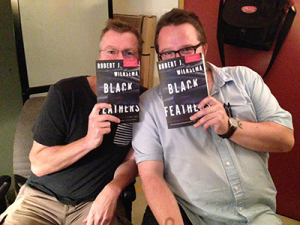
Over at The Province, I talk to Victoria author Robert J. Wiersema about the writing life, literary tattoos and why he loves Buffy the Vampire Slayer so damned much. We also talk about his new novel, Black Feathers, which is his most Stephen King-like yet!
From barista to plumber!
I had a great conversation with Vancouver fantasy writer Sebastien de Castell about his new blockbuster book deal — eight books over four years! — and how he’s finally earning plumber money. Seriously, Sebastien is a great writer and a fun interviewee. Check out the article and the podcast!
Feverish dreams

I’ve been sick with a norovirus that swept through my household recently like, well, like a plague. I tried to avoid it by wearing a medical face mask and gloves while I tended to sick children and a spouse but eventually it claimed me. The unexpected bonus to lying in bed alternating between fever and chills and other such delights was that I had some crazy visions of new Cross adventures that would make awesome short stories. Very strange, very hallucinatory Cross short stories. So I’ve been working on those. I’ve written a story and a half so far, with notes for two other short stories. So there may be a Cross story collection at some point in the future.
Or maybe I’m still sick and just imagining all this writing stuff.
CanLit’s $100,000 controversy
The CanLit community recently went crazy over a publishing exec’s comment that he wasn’t interested in publishing books that earned less than $100,000. Of course, it’s a little more complicated than a publisher just being about the money. I talked to a number of writers and publishing professionals about their reaction to the controversy over at The Province.
“A blasphemously good time”
I am thrilled to be included on this list of awesome reads by Corey Redekop. Clive Barker and Nick Cutter for neighbours? Well, let’s just say if I go missing you know who to question first.
Author Ian Weir loves grave robbing and raising the dead
My podcast with Ian Weir, author of Daniel O’Thunder and Will Starling, is live over at The Province. Listen to our conversation to discover why Ian loves grave robbing, Frankenstein and getting nominated for awards.
Tell me again how piracy isn’t a problem
Author Silvia Moreno-Garcia woke up this morning to find someone has pirated one of her stories and is selling it on Chapters online — under Silvia’s own name. It’s a pretty devious act of piracy, as it looks like a legit book from the writer, but I’m pretty sure Silvia will never see any of the money from the sales of her own pirated work. And people wonder why most writers can’t quit their day job….





 peter darbyshire