Category Archives: Journal
Play This: Horrified
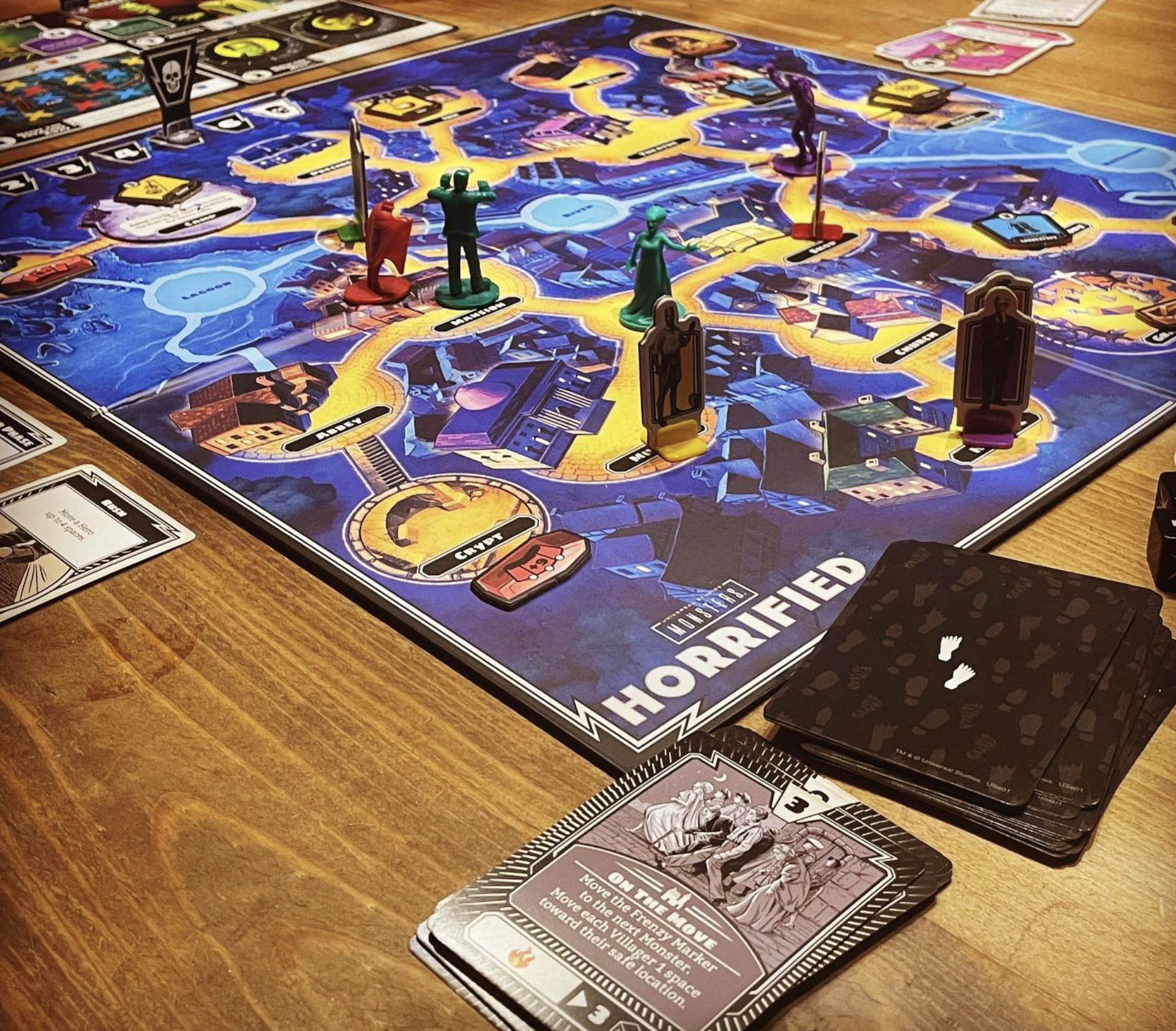
The Horrified series of games have become my favourite board games since the original Horrified launched back in 2019. The games are wonderfully cooperative and intriguingly different in each version — or even each gaming session. They’re also beautifully designed and a pleasure to interact with. I’m not the only one who thinks so — almost everyone I’ve introduced the game to has ended up buying one of the versions of it. I’ve become an evangelist of horror!
The premise is simple: work together to defeat the monsters before the monsters defeat you. In the original game you are defending a town against classic movie monsters: Dracula, Wolfman, the Mummy, the Invisible Man, the Creature from the Black Lagoon, Frankenstein’s creature and his Bride. The monsters move around the board and cause mayhem according to monster cards, which are full of surprises sure to derail player plans.
Each character chooses a different hero character with special abilities to help in the fight against the monsters: the mayor, the archaeologist, the explorer, the courier, the professor, the scientist and the inspector. The trick for players is using these special abilities well to complement each other. Collaborate and plan and you will have a chance to save the town. Play as a lone wolf and the monsters will surely prevail. As a former academic, I have a soft spot for the professor but they all have their advantages.
Different items are scattered around the beautifully designed board for players to use, either in defending themselves against the monsters or satisfying certain requirements to defeat the monsters. For instance, to defeat Dracula players must find his four coffins in the town and destroy each with items they have collected, then track down Dracula and destroy him with a different set of items. Haven’t been collecting enough items? Enjoy watching Dracula feast on townsfolk.
Each of the monsters must be destroyed in different ways, which means the players can’t simply use the same strategy for each. To make it even more challenging, there’s a time limit of sorts. A terror marker gets moved each time a player or one of the townsfolk gets killed by a monster. Reach the end of the terror track and the players lose. So the players feel the pressure rising as the game goes on and they get more desperate.
The townsfolk are mostly helpless victims that can’t defend themselves, but they do provide help to the players in forms of perk cards if the players escort them to their desired safe locations. The perk cards can be used to prevent monsters from moving, giving the players extra actions, and so on. You can win without the cards but it’s that much more difficult.
Each game session is remarkably different thanks to the randomness of the cards that determine the monster actions and townsfolk appearances. There are also different levels of difficulty, where you can play against more challenging monsters or greater numbers of monsters. I’ve lost track of how many times I’ve played Horrified, but it’s almost always the first pick for my gaming crew.
So check out Horrified today and get ready to have a horrifyingly good time!
The Wonder Lands War on Transactions With Beauty
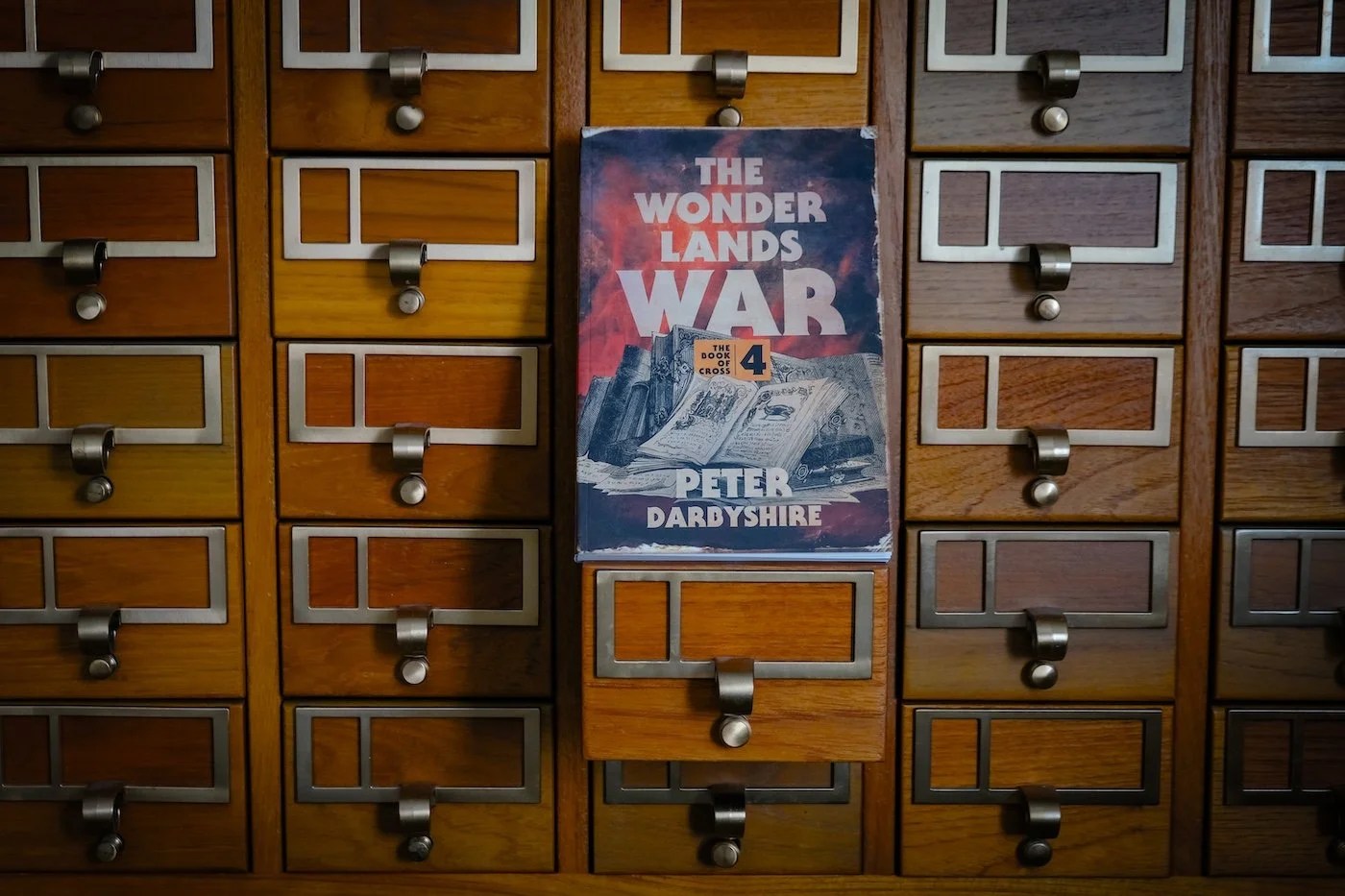
I’m thrilled and honoured to see my latest book, The Wonder Lands War, get a shoutout at Transactions With Beauty!
Transactions With Beauty is run by the amazing writer Shawna Lemay and offers thoughtful mediations on art, books, calmness, culture, music and lots of other subjects. It’s long been one of my favourite reads, so this is truly special to me.
The Write Life: What kind of book is this?
Before you begin writing your book, it’s important to know what kind of book you’re writing. Is it horror, sci-fi, fantasy, romantasy, literary fiction, etc.?
It’s important to know the nature of your book to help you and others understand how it fits into genre categories and thus the marketplace. If you care about such things, that is. No judgement from me if you don’t, as I often don’t think of the marketplace at all. But trust me when I say your life as a writer will be easier if you do consider the marketplace before you start writing.
If you don’t like writing to genre categories, you can always mix things up a little and create a hybrid. Romantasy came out of the fantasy and romance genres, after all, and it’s the biggest thing in publishing right now — maybe even ever.
Once you have the basic genre established in your mind, you need to consider the book’s form, its defining structural or stylistic feature. Here’s a quick overview of some of the more popular ones and more or less contemporary examples.
Quest
A hero or group of heroes pursue a specific goal, overcoming obstacles to achieve the goal.
- Lord of the Rings by JRR Tolkien
Picaresque
A roguish, lower-class protagonist moves through society in an episodic manner.
- The Blacktongue Thief by Christopher Buehlman
Epistolary
A tale told through letters, diary entries and other documents.
- This Is How You Lose the Time War by Amal El-Mohtar and Max Gladstone
Bildungsroman
A coming of age tale, often with moral development.
- His Dark Materials series by Philip Pullman
Kunstlerroman
A chronicle of the development of an artist.
- A Portrait of the Artist as a Young Man by James Joyce
Unreliable Narrator
A tale told from the POV of a character that cannot be trusted.
- Gone Girl by Gillian Flynn
Story Within a Story
A tale that is often about storytelling itself because of its very nature.
- Invisible Cities by Italo Calvino
Historical Fiction
A tale set in a carefully researched past, often meant to highlight issues in the present day.
- Libra by Don De Lillo
Gothic
A story set in an atmosphere of dread and decay with supernatural overtones.
- Crucible of Chaos by Sebastien de Castell
Dystopia
An imagined society used to critique the present or at least present trends.
- The Handmaid’s Tale by Margaret Atwood
Metafiction
A tale that draws attention to its own fictionality, often to mediate on creativity but sometimes to critique social or cultural issues.
- If on a Winter’s Night a Traveller by Italo Calvino
Satire
A comic tale, often dark, meant to mock or critique some element of society or current trends.
- Catch-22 by Joseph Heller
There are many more forms of novel than this, of course. And writers often combine different forms and structures to create innovative new works and entirely new structures. But it’s important to have an understanding of the classics before you set out so you can have a vision for your own work.
Remember, you are entering a literary conversation of the ages! Make sure you understand the language first.
Related
Careless Necromancers: The March 2026 Bibliofiles
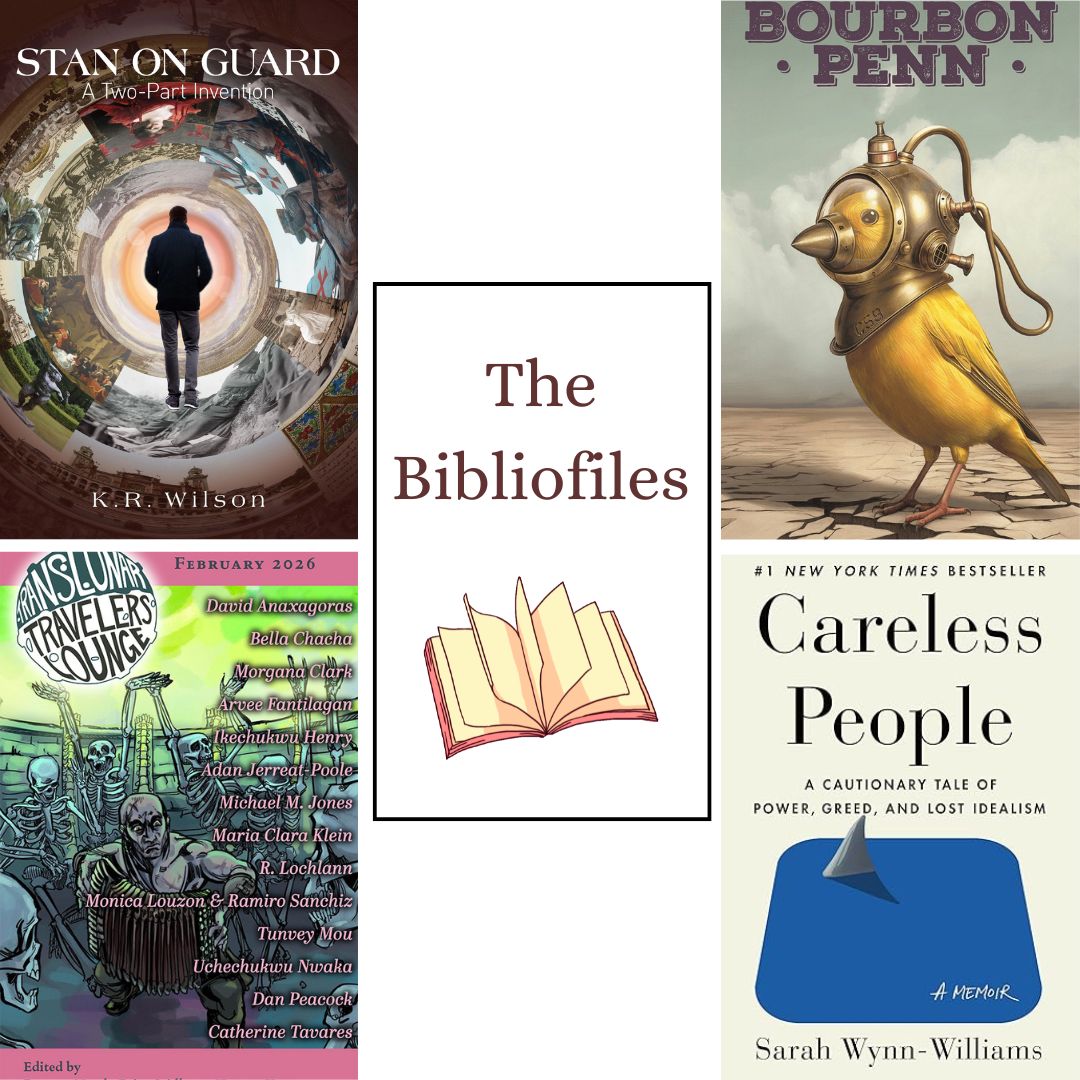
I managed to get a bit more reading done this month, thanks to some time off during spring break. It still wasn’t enough to drown out the insanity of the current state of the world, though. Ah well, there’s always next month.
Fiction
Stan On Guard by KR Wilson
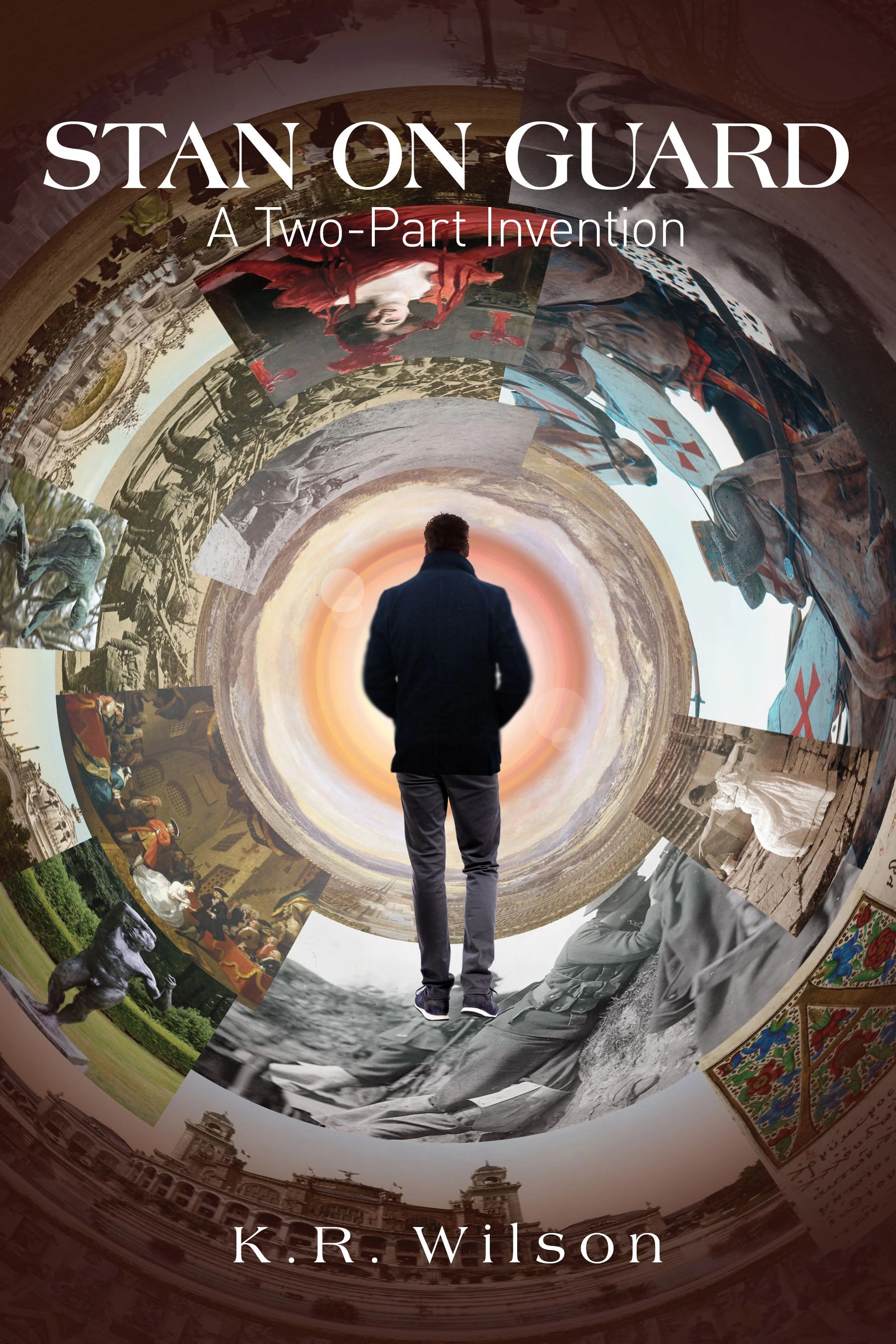
A pair of immortals live through the world’s ages, getting caught up in both history and myth, hanging out with infamous characters such as Odysseus and Nietzsche, while locked in a deadly dance.
No, I’m not talking about my Cross series of books. This is the premise of Stan on Guard by KR Wilson, the followup to Wilson’s book Call Me Stan. It’s a wild ride through history, the arts, philosophy, mythology, psychology and a whole lot of other things. If you like the Cross books, you should check out Stan on Guard.
Link: https://guernicaeditions.com/products/stan-on-guard
The Necromancer’s One Weakness by R. Lochlann
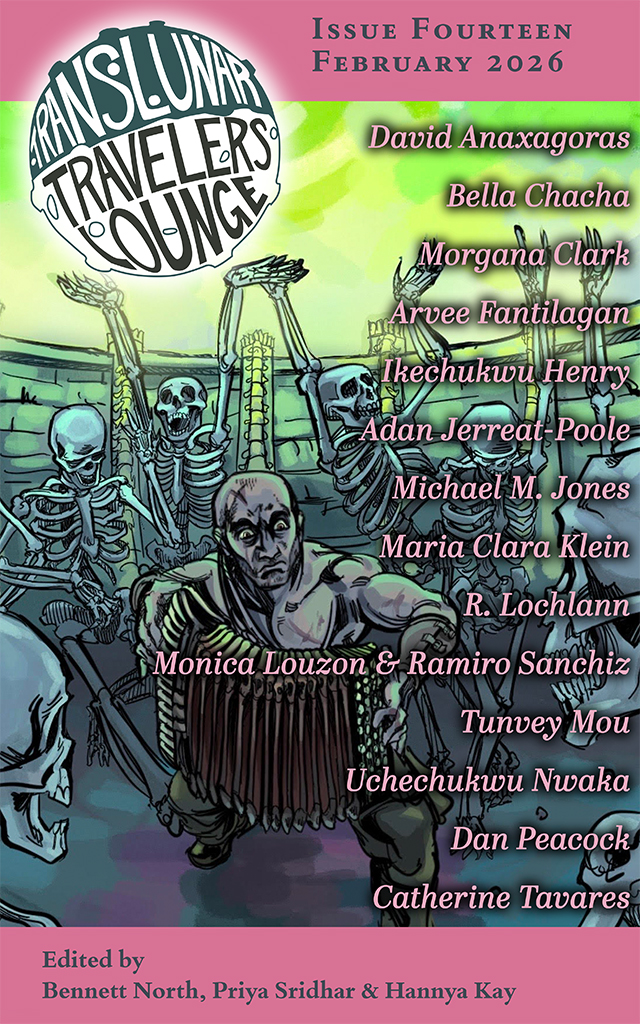
I have to admit that I wasn’t expecting a story with “necromancer” in the title to feature a barbarian bard who beats people to death with an accordion. Or that the necromancer’s sole weakness was xylophones. Or the idea of agents to adventurers. But these things all come together in harmony in this delightful little tale.
Link: https://translunartravelerslounge.com/2026/02/15/the-necromancers-one-weakness-by-r-lochlann/
Atomic Chess by Josh Pearce
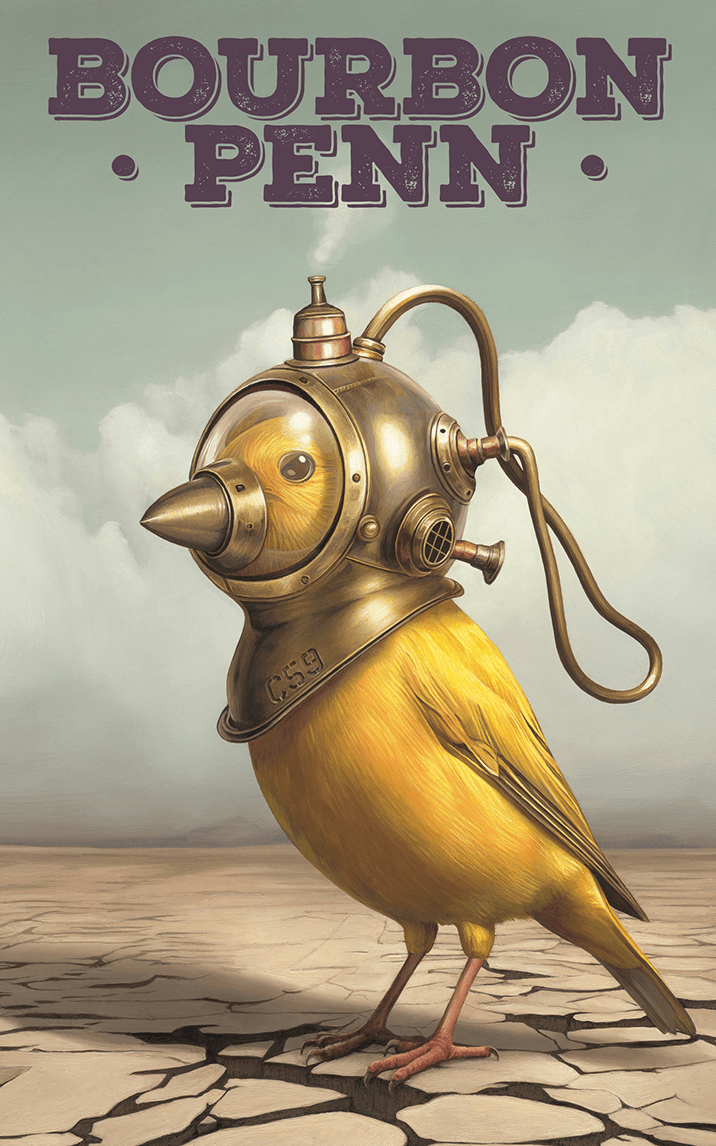
“Project upon the cosmos whatever system of understanding you wish.”
An eerie tale of a physicist conducting experiments in a submerged Russian submarine, combined with a encrypted chess game in a cafe between the only survivor of the lost submarine and a member of a mysterious intelligence organization.
Atomic Chess is as existentially weird as a Lovecraft tale and as delirious as Max Barry’s Lexicon, with more than a dash of Cold War spy thriller thrown in. One of the most intriguing stories I’ve read yet this year.
Link: https://www.bourbonpenn.com/issue/38/atomic-chess-by-josh-pearce
Non-fiction
Careless People by Sarah Wynn-Williams
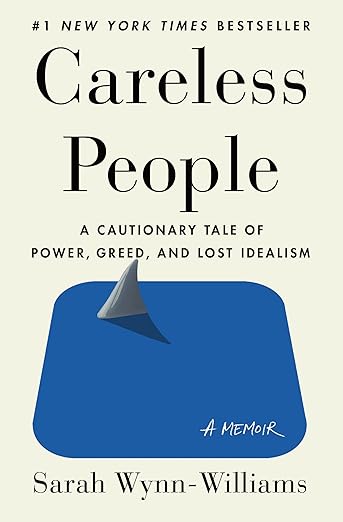
If you use any Meta service — Facebook, Instagram, Threads, etc. — you should probably read Careless People by Sarah Wynn-Williams. An insider account of her time working alongside the leaders of Facebook, including Mark Zuckerberg and Sheryl Sandberg, Careless People follows Wynn-Williams as she forces her way into a role at Facebook because of her belief that it can change the world, only to to spiral into despair at how it changes the world.
The Meta that Wynn-Williams describes is a world of greed and obsessions with power, where those calling the shots don’t care about the negative outcomes of their decisions as long as it increases their reach and thus bottom line. Wynn-Williams reveals moment after moment where Meta leadership appears to have lied outright to the public and to governments, where they make choices they know will cost lives, where there is no greater good.
And then there are the personal anecdotes of harassment by managers aided by complicit human resources, to say nothing of just plain weirdness such as when Sandberg makes staff sleep with her on flights.
Perhaps the most telling bit in the whole book is the reaction of Meta’s leadership to discovering the role Facebook had in getting Trump elected. Rather than being appalled, Zuckerberg seemed intrigued by the technical aspects and even delighted by Facebook’s potential. Sandberg comes off even worse, wondering if Facebook can hire Trump’s social media guru.
Careless people indeed.
Link: https://read.macmillan.com/fib/careless-people/
The big fix for Canadian publishing by Kenneth Whyte
Does Canada need a Book Law to protect Canadian culture?
Link: https://shush.substack.com/p/the-big-fix-for-canadian-publishing
History’s biggest book heist by Kenneth Whyte
A short history of book piracy in the name of technological progress. The AI companies scanning pirated books to train their LLMs are just the latest in a long series of those who believe authors and publishers shouldn’t be compensated for use of their works.
Link: https://shush.substack.com/p/historys-biggest-book-heist
The Day NY Publishing Lost Its Soul by Ted Gioia
“Literary culture can’t survive in a world of risk avoidance, stale formulas, and clownish covers.”
The death of the midlist writer and what’s next.
Link: https://www.honest-broker.com/p/the-day-ny-publishing-lost-its-soul
The Coming Clash of Civilizations by Mike Brock
Do the technocrats want a return to feudalism? Hell, we’re already halfway there.
Link: https://www.notesfromthecircus.com/p/the-coming-clash-of-civilizations
Happy World Theatre Day!
Happy World Theatre Day! I got my start in the arts working in theatre and I often miss those days. It’s what inspired my second Cross novel, The Dead Hamlets, which features theatre ghosts, Shakespearean spirits, mischievous faerie, an undead Christopher Marlowe and more.
Reflecting on the day, I realize many of the most magical moments in my lives have happened in theatres. Working on a production of Sondheim’s Sweeney Todd in London, Ont., where the music changed my very DNA; being caught in a storm in Shakespeare’s Antony and Cleopatra at the Barbican in England that was as real as any other despite it just being actors on a stage with ropes; remaining mystified to this day by enigmatic judges appearing out of nowhere in a production of Kafka’s The Trial in London, England; and so many more!
Theatre is one of the oldest art forms and continues to persist because it is perhaps the most social. Where else can we gather in a communal space and participate in the same shared imaginative experience? Where else is the audience so necessary to the artistic experience? There’s a creative energy or perhaps a creative relationship that takes place between the performers and the audience, where the space becomes alive with a new world that transcends our own if only temporarily.
Theatre is often a place for working out ideas in that community, from the ancient Greek tragedies and comedies to the present day. I’ll never forget the production of David Mamet’s Oleanna I saw at the Grand Theatre in London, Ont., where the audience engaged in a lively debate after the show about the merits of political correctness (this was before woke culture had emerged). Is this any different from, say, Lsysistrata by Aristophanes or The Doll House by Ibsen?
And theatre remains one of the most important areas for academic studies, not only because of its historical context but also because theatre has a strong history of formal experimentation and political messages.
The influence of theatre is seen on other mediums as well. While film has largely taken the place of theatre in our culture, it remains heavily influenced by theatre. And many of the most popular films are adaptations of plays. Stoppard’s Rosencrantz and Guildenstern Are Dead is a favourite film and play of many, including myself. Even the world of theatre often finds itself immortalized in film, such as Shakespeare in Love — which was sold out when I saw it the first time.
Much applause for all the theatre folk who bring magic to a world that desperately needs it. Join them in a theatre in your community and help create and experience that magic.
We tell ourselves stories to imagine a different world
Have you been turning away from the world of late and finding sanctuary in books or other forms of art? If so, you’re hardly alone.
The publishing world has seen a boom in the fantasy genre, as readers seek escape from the present times where we find ourselves increasingly powerless before tech autocrats and self-serving politicians who want to destroy the existing order and rob us all of the meagre lives and agency it has brought us. At least in fantasy novels individuals have a chance of changing the world and good can actually win out over evil. Escapism yes, but perhaps inspirational escapism.
I’ve been particularly drawn to urban fantasy because of the way it transforms the existing world into one with magic and mystery. Urban fantasy re-injects wonder into our world — and we are seriously lacking in wonder at the present moment. We need something that can transcend this miserable existence but also change it, in the imagination if nowhere else. The magic of urban fantasy promises the re-enchantment of the mundane.
It’s why I focused on the act of creativity as magical and mysterious in my most recent book, The Wonder Lands War. Books become portals to other realms in The Wonder Lands War, with Lewis Carroll’s Wonderland tales acting as gateways into the imagination itself (among other places). Libraries are secret bastions of power while librarians are not so secret magicians. And paintings, sculptures and books offer keys to immortality and escaping death.
Of course, I’m not the only one who sees something magical in creativity.
The poet William Blake saw the imagination as the remnants of divinity in our soul, a sort of personal connection to a spiritual realm. The more contemporary poet Christian Wiman says in He Held Radical Light that “there is a persistent, insistent mystery at the center of our existence, which art both derives from and sustains.”
And musician, writer and 21st century theologian of sorts Nick Cave discusses a similar conjunction of creativity and transcendent mystery in Faith, Hope and Carnage with journalist Sean O’Hagan, where he says “You have to operate, at least some of the time, in the world of mystery, beneath that great and terrifying cloud of artistic unknowing.” To Cave, the creative impulse is a spectral or perhaps transcendent force that calls creators to follow it rather than the other way around.
These acts of the imagination manifest themselves in the real world in the form of artistic creations and provide knowledge and comfort. There is a reason so many of us seek solace in bookstores and libraries, in art galleries and museums. One of my favourite literary moments is in Roger Zelazny’s Nine Princes in Amber, where the protagonist Corwin reflects on the magical power of libraries, where he feels “comfortable and secure to have walls of words, beautiful and wise, all around me. I always feel better when I can see that there is something to hold back the shadows.”
The reference to shadows takes on extra resonance in the Amber books given they form sort of a multiverse series with different realities being shadows of the one true realm, Amber, which was carved out of the chaos through an act of creation. Corwin’s father created the Pattern, a magical shape that gives order to Amber and thus existence, but the farther you get away from this act of creation, the more threatening the shadows become — until eventually you reach the Courts of Chaos.
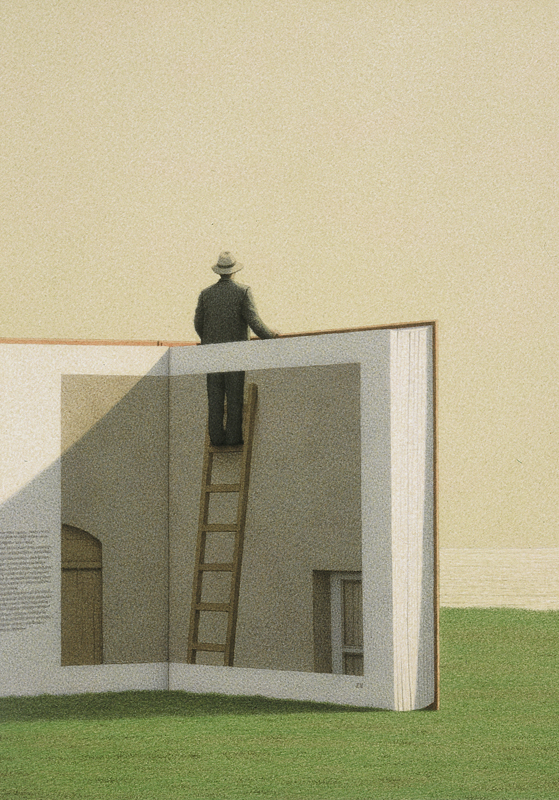
Similarly, the paintings of Quint Buchholz see the world of the imagination as real as our own, often using books as vehicles to move between these realms – to suggest they are both equally as real.
And are they not?
Umberto Eco argues creativity is the foundation of our very civilization, with books being the building blocks of our world.
“Literature creates a sense of identity and community,” he says in On Literature. “We might also think of what Greek civilization would have been like without Homer, German identity without Luther’s translation of the Bible, the Russian language without Pushkin, or Indian civilization without its foundation epics.”
The real world is made up of a history of acts of the imagination then. “A text is meant to be an experience of transformation for its reader,” Eco says in The Name of the Rose, but texts also transform the world itself.
Is it any wonder then that literary characters often take on a life of their own in our world? See, for instance, Timothy Findley’s Headhunter, where Kurtz is freed from Joseph Conrad’s Heart of Darkness in Toronto. Or The Unlikely Escape of Uriah Heep by HG Parry, where someone is pulling literary characters from books and into our world.
I feel so strongly that some characters have developed their own life that I gave them just such a life in my Cross books, which are set in the modern world. Alice from the Wonderland tales, Frankenstein’s creature from Mary Shelley’s tale, Ahab from Melville’s Moby-Dick, Captain Nemo from Jules Verne’s 20,000 Leagues Under the Sea and more make appearances in the world we find ourselves in — and hopefully add a little more magic and wonder to our world.
“We tell ourselves stories in order to live,” Cave says.
We also tell ourselves stories in order to live in a different world.
Image: Man on a Ladder by Quint Buchholz
My Favourite Bit of The Wonder Lands War
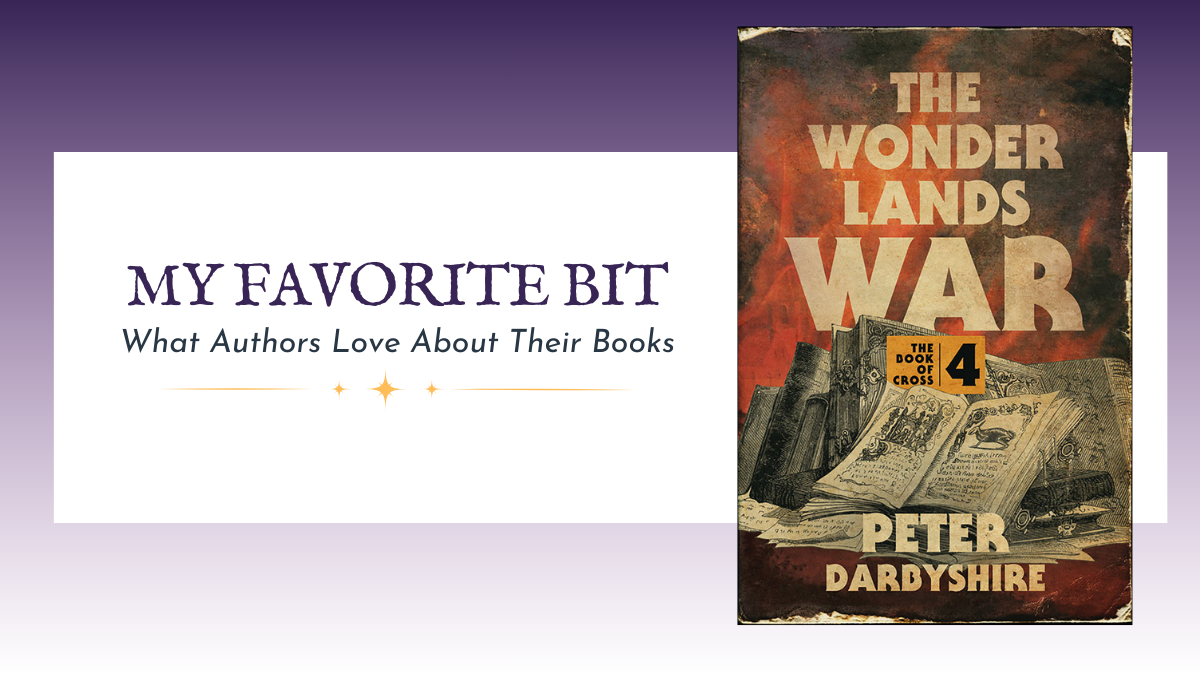
What if your favourite places from books, paintings and other works of art were real?
I’m over at Mary Robinette Kowal’s site talking about My Favourite Bit of The Wonder Lands War, which features the immortal rogue Cross trying to find the Wonder Lands — the faerie realm that inspired the Alice in Wonderland tales — so he can save Alice from a rogue group of angels.
“The Wonder Lands War is a descent into a literary rabbit hole, where I try to capture the spirit of the original Wonderland books and meld it with the Cross universe. While Cross’s quest takes him to many fascinating places — magical libraries with supernatural librarians, a Venetian island of murderous and undying priests, a secret tomb for an angel within the Vatican — my favourite place in the book is the Wonder Lands, which are more dangerous than their literary counterpart.”
The Write Life: Write wonder
Every writer hears the advice “write what you know” at some point or another because it’s useful advice. Writing what you know inserts authenticity into your work, to say nothing of confidence. It’s particularly valuable advice if you’re writing in a genre where people may be intrigued by what you know – a doctor writing medical thrillers, a forensics expert writing mysteries, a biologist writing sci-fi and so on.
Writing what you know can come with its own limitations, though. If you’re restricting your subject matter to your own experience or even just your own point of view, you’re shutting out most of the world from your work. Even worse, you’re closing down an endless universe of imagination.
Write what you know, sure. But above all, write wonder.
Write about the things that cause wonder in you. This will keep you interested in your work, which matters more than most writing advice acknowledges. Your exploration of ideas will make it more compelling to readers if it hooks your own imagination. You have to be curious about your own writing and enjoy its journey. If you’re not feeling wonder at the tale, then how can the reader?
You must also write to cause wonder in others. Write about those universal subjects that capture all our imaginations, the things that transform us and send each of us off on our own journeys. Make the reader think, make them experience. They don’t all have to experience the same things and perhaps it’s best they don’t. But make them feel something.
Remember that a book is not just a stand-alone object. It is part of a broader conversation of ideas, characters, worlds and experiences. When a reader finishes your book and something in it stays with them, that’s the book joining the ongoing conversation of all that’s ever been written. You’re not just making a product here. You’re adding your voice to something much larger than yourself.
Write what you know but don’t stop there.
Write into the unknown. Write the question you don’t know the answer to. Write the world you haven’t visited yet.
Write wonder.
Related
Most books are now self-published
Most books that are published now are self-published.
Publisher’s Weekly has an interesting article on the increase in the number of books published with ISBNs in the U.S. jumping 32.5% in 2025, with the majority of books being self-published (3.5 million of 4 million). In other words, more than 80% of books in the U.S. last year were self-published.
I mentioned this news to an agent friend of mine and he believes the number of self-published books is even higher as many do not have ISBNs and thus wouldn’t be included in this data.
Is self-publishing the model of the future for writers? Or the model of the present even?
Most writers I know are already hybrid, where they publish some books with traditional publishers while self-publishing other works.
It’s an interesting time to be a writer. There has never been more opportunities to publish your work. The challenge now isn’t getting your books out there, it’s getting them noticed amid all the other books. I suspect the real value of publishers in the future will be less about distribution and more about driving conversations about their books in the attention economy.
The world needs urban fantasy now more than ever
The rise of fantasy fiction and particularly romantasy may have its roots in escapism from the absurdity of the real world, but what about urban fantasy? Is there still a place for it in our literary landscape? Or is the real world beyond redemption?
For those unfamiliar with urban fantasy, it’s a subgenre that typically uses the real world as a setting but infuses it with supernatural or magical elements. The inhabitants of the real world are usually oblivious to all things weird in their world but not always. My Cross series of supernatural thrillers, for instance, is urban fantasy.
The urban fantasy genre has been going strong since the 1980s or so and has proven to be highly adaptable to publishing trends, mixing it up with romance, mystery, horror and more.
But is it still a viable genre for the 21st century, where the elite do what they will with no repercussions, wars are endless Groundhog Day distractions, global orders are disintegrating, and AI threatens to leave everyone jobless if not turned into paperclips? Can literature even engage in any meaningful way with a world like this?
The data suggests so. Urban fantasy accounted for around 25% of sales in 2025, and an increase in late 2025 indicates that urban fantasy is increasing in popularity even more. Readers haven’t given up on our world yet.
I firmly believe that it is time for a resurgence of urban fantasy. The world is seriously lacking in wonder — and I don’t mean WTF wonder but magic. We need something that can transcend this miserable existence but also transform it, in the imagination if nowhere else.
Because the imagination is the ultimate reality, isn’t it? It’s how each of us perceives the world and shapes it — how we understand the world.
The magic of urban fantasy is something that ruptures reality, that plays by different rules or no rules at all. It rejects the logic of the world and promises freedom and change.
Urban fantasy is the re-enchantment of the mundane, the promise of a world that is more than bland and generic offices, algorithms and billionaires that exploit us at every turn, and lives with no future. In urban fantasy deeper meaning to our existence isn’t gone, it’s simply hidden and waiting for us to discover it.
The world needs urban fantasy now more than ever to show us what it can really be.




 peter darbyshire