Author Archives: Peter Darbyshire
Early release of Azrael and the Dead Man’s Hand

My latest tale of Azrael the angel gunslinger, “Azrael and the Dead Man’s Hand,” is available for early download for supporters of the Beneath Ceaseless Skies Patreon. What happens when the angel Azrael wanders into a strange town and becomes trapped in a deadly and supernatural poker game? You’ll have to read the story to find out!
This marks the seventh Azrael tale in Beneath Ceaseless Skies. Here are the others in order of publication:
- The Angel Azrael Rode Into the Town of Burnt Church on a Dead Horse – The angel Azrael rides into the town of Burnt Church for a drink and ends up helping the very strange inhabitants fight off a gang of demons that’s been tormenting them.
- The Angel Azrael Delivers Small Mercies – The angel Azrael encounters an angel who is determined to turn the world into her own personal Hell and only Azrael can stop her.
- The audio version of “The Angel Azrael Delivers Small Mercies” with a new introduction I recorded for the story
- The Angel Azrael Delivers Justice to the People of the Dust – The angel Azrael rides into a mining town that is under siege from curious bone creatures stealing the town’s children. When Azrael intervenes, he discovers that nothing is what it seems in this strange place.
- The Angel Azrael Encounters the Revelation Pilgrims and Other Curiosities – The angel Azrael is hired by a group of pilgrims to guide them through a dangerous stretch of land, where they encounter a city of the dead and an outlaw band of half angels intent on ensuring they don’t make it to their destination.
- The Angel Azrael and the War Ghosts – The angel Azrael tries to stop a group of ghostly soldiers from preying upon travellers and rides straight into his own troubled past.
- The Angel Azrael Battles a Dead God Among the Heretics – The angel Azrael encounters a village full of crazed golems intent upon resurrecting a dead god to unleash upon the world — a god that Azrael has already killed once.
If you like the Azrael stories, please share them with a friend. Word of mouth is one of the best forms of recommendation for a writer and helps lead to new readers. And new readers means the kind of support a writer and journals like Beneath Ceaseless Skies need for new stories.
As always, thanks for reading.
No ghost in the machine?
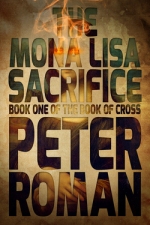
I recently checked to see if any of my books were included in the books data set used to train AI systems and found The Mona Lisa Sacrifice and The Apocalypse Ark — Books 1 and 3 of my Cross series of supernatural thrillers. Book 2, The Dead Hamlets, was not included. I don’t quite know how I’m supposed to feel about that. Pleased? Irritated? The tale of Cross battling an order of renegade angels to free the gorgon Mona Lisa from their imprisonment is good enough? As is the tale of Cross desperately trying to stop the mad creature Noah from ending the world with his eerie ark at the Sunken City? But the tale of Cross becoming trapped in a ghost story featuring the original Hamlet ghost isn’t good enough for an AI?
I know I should probably have an opinion on whether or not books should be used in this manner, and I do: authors should be consulted on how their works are adapted or used and compensated appropriately. Without those basic rights, it’s a lot harder for authors to be able to keep creating the works we do. But I’m also too exhausted to say much else about it because, well, 2023.
And if the AIs run amok and try to end the world I’m really sorry about that….
The good news is that if the world doesn’t end the Cross books will be republished in 2024 with Wolsak and Wynn! Hopefully they’ll find some new human readers.
(Thanks to George Murray for the reminder about the data set. He has some thoughts about the whole issue in a recent Walrus article that is worth checking out.)
The end times newsletter

I’ve just sent out my December newsletter, which collects a bit of publishing news (a new Azrael the angel gunslinger tale coming in the new year!), some recommended reads and views, and a bit of personal miscellany.
One note: The newsletter service that I use, Tiny Letter, is shutting down in February. I’ll likely migrate the newsletter to Substack as that seems to be working well for other authors and readers alike, but I’m open to suggestions.
Various apocalypses now 25% off

Wolsak and Wynn, the publisher of my book Has the World Ended Yet?, is holding a holiday sale of 25% off all books. Affordable apocalypses for everyone! Click on the image above to check out Has the World Ended Yet? – or click here.
Indie publishers like Wolsak and Wynn are incredibly important to literary culture, so I urge you to check out the rest of their amazing books and support other writers like myself here.
As always, thanks for reading!
On the Bookshelf: The Lonely City by Olivia Laing

During one of my lonelier periods as a young man I used to spend a lot of time wandering the city where I lived. Loneliness drives us to be around others or maybe to escape ourselves. Such moments tend to amplify the condition, though, as there’s nothing like feeling isolated in a crowd of strangers to really highlight your loneliness.
I’m tempted to say my wandering was aimless, but it wasn’t. It was undirected perhaps, but intentional. I wanted to experience some connection to others or perhaps even to the city itself. So it was I found myself in settings that inevitably attract the lonely — cemeteries, churches, hiking clubs, cafes, writing groups and the like. Who knows how many people like me were also in those places, searching for some connection? Entire communities, perhaps.
It’s this sense of communities of the lonely that pervades Olivia Laing’s book The Lonely City: Adventures in the Art of Being Alone. Equal parts autobiography, biography, art history, art theory and philosophical musing, the book chronicles Laing’s physical and emotional journeys after a breakup and connects them with biographies of famous and little known artists who all searched for or depicted dis/connection themselves in some form or another — Andy Warhol, Edward Hopper, Billie Holiday, Jean-Michel Basquiat and more. We learn about Warhol’s obsession with chronicling everything in his life to surround himself with an ever-present if virtual community, we consider the barriers to connection in Hopper’s famous painting of a cafe at night — the canvas and then windows separating the viewer from the subjects of the painting, who are themselves mostly isolated from one another, in a city cafe that seems to have no entrance or exit — and we experience Laing’s longings that will be so familiar to so many of us.
It’s a meandering yet purposeful book that somewhat alleviates the emotional crisis of loneliness by drawing the reader into Laing’s life and connecting author and reader both to a broader community of yearning souls. The entire book becomes an act of communion of sorts, where we can transcend our isolation by understanding the isolation of others who, despite their fame, were often more alone than we can ever imagine and who were able to convert their disconnection into a form of transcendence through their art. After all, what is a painting or a book or a song or even this review if not an attempt to communicate with others, to connect with others?
“Loneliness might be taking you towards an otherwise unreachable experience of reality,” Laing writes at one point. Isn’t that what all our wandering is about in the end?
The joy of indie publishing
My publisher Wolsak and Wynn on why they do what they do (which also happens to be why I love publishing with them):
“We’re publishing books we want to read. The books that you can’t find easily, stories that surprise us, writers that delight us. While we’re also quite sure other people will like these books too, someone here, at the press, has to feel the book is pretty special for us to take it on. Because you really can’t tell which books will take off, someone has to be willing to say, This book is important, full stop. Let’s publish it. I want to read it.”
Wolsak and Wynn was also featured in a recent Toronto Star profile of indie publishers in Canada.
“The Angel Azrael Battles a Dead God Among the Heretics” is a recommended read

I’m honoured to see my latest tale of Azrael the angel gunslinger, “The Angel Azrael Battles a Dead God Among the Heretics,” is included in this month’s Maria’s Reading roundup by author Maria Haskins. If you’re a fan of sci-fi, fantasy, horror or any combination of those genres, then you need to follow Maria! Fair warning, though: your to-read list is going to get really long….
You can find links to all the Azrael stories and read them online for free here.
On the Bookshelf: The Devil’s Detective

The Devil’s Detective by Simon Kurt Unsworth is one of the creepiest and disturbing visions of Hell ever created. Not because it’s all horrible monsters and terrible torments, but because it’s so close to our own world.
The book follows an Information Man aka detective in Hell named Fool. He is tasked by Hell’s incomprehensible bureaucracy to investigate murders in the infernal realm, which resembles a 1940s/50s town on the edge of a dying rural area (in my reading of it anyway). The setting synchs nicely with the noirish voice of the book, but Fool isn’t exactly your typical noir detective. For one, he never actually solves any murders. Every investigation gets closed with paperwork that says “Did Not Investigate,” and he works for the demons instead of being some sort of lone knight. The dead never get justice when they are killed by demons. Instead, they are tossed back into the seas of limbo, where they will be plucked out again at some future point to begin their torment again.
And torment it is, for those trapped in Hell are forced to endure never-ending labour for the demons with no source of light or happiness in their lives. Instead, there is only the constant existential anxiety of when not if those same demons will decide to turn on them and devour their souls. There’s no escape, not even for the demons, who were here long before the humans came and don’t seem that happy about Hell themselves. It feels like a manifesto against capitalism at points — the entire world seems dedicated to the torture of humans by the machinery of work, with overseers/managers being actual demons that want to feed on their workers’ souls — but it’s a familiar enough world that most readers will see their own personal Hell reflected in it.
Everything changes when the angels arrive, though. Fool is ordered to escort a group of them through Hell at the beginning of the book, when they are on a mission to seek out souls for ascension to Heaven. And this is where the truly chilling aspect of Hell becomes manifest. For the angels reveal there is just the tiniest shred of hope for escape from Hell — but it seems almost random. And it’s that hope that highlights all the other suffering. If there was no chance whatsoever of escape, perhaps the damned would eventually grow accustomed to their suffering or maybe even try to do something about it. But instead they are always captured by hope of escape to Heaven, even though they stand nearly no chance of ever seeing that hope realized. Hell is truly to be found in hope.
When the angels visit, Fool is drawn into a very curious string of murders in which the victims seem to be released from Hell. The question is who’s behind the murders and what they want, as the killings kick off a rebellion of sorts in Hell, where the damned rise up against their demon masters and Fool is caught in the middle. By the time he solves the mystery, all of Hell has been transformed. And even the demons don’t know what comes next.
The Devil’s Detective is a truly fabulous read that combines a number of genres into a chilling, terrifying and yet truly beautiful story. You’ll never think of Hell the same way again.
- Related reading: Nathan Ballingrud’s Wounds: Six Stories from the Border of Hell. It takes the opposite approach from The Devil’s Detective and presents Hell as something incredibly alien and ultimately unknowable. Very creepy and very beautiful. It’ll worm its way right into your soul.
On the Bookshelf: The Scroll of Years by Chris Willrich

I thought I’d resume discussing my current reads here on my journal, as I try to resist the irresistible trend of social media becoming the default platform for all conversations. (See my reasoning here.)
First up On the Bookshelf: The Scroll of Years by Chris Willrich.
I fell in love with Chris Willrich’s tales at first read, after coming across them in Beneath Ceaseless Skies. I was so excited about them I messaged BCS editor Scott Andrews to let him know, and he pointed me to Willrich’s novels.
I recently finished The Scroll of Years, and I still don’t know how to talk about it. Perhaps because it’s one of those books that defies categorization. A risky move for a genre book, sure, but one that’s paid off in this case.
It’s as if it were a fantasy novel co-written by the ghosts of Italo Calvino and Fritz Leiber and transcribed by a dragon monk who sees only in ethereal. This is a tale that revels not only in unconventional characters and unexpected twists but also in storytelling itself. In fact, this is very much a novel about storytelling at every level — the characters’ greatest powers are their abilities to tell tales, the narrative ventures into one different genre after another, and the idea of being able to escape into a good story is actually key to the plot here.
The book mostly follows the thieves Bone and Gaunt, lovers that are trying to escape their pasts and find a safe spot to raise their coming child. But the narrative often shifts away from them to explore other characters’ tales that intersect with the story of Bone and Gaunt. And it’s a wildly imaginative cast of characters — weird magical assassins, a band of mysterious thieves, and even an unconventional dragon. To say any more would be to reveal too much!
The Scroll of Years isn’t traditional fantasy — it’s certainly not high fantasy or grimdark. Nor is it an easy read, as it demands your attention at all times. But it is a unique read and unlike anything else being published at the moment. The literary magic and originality of it alone are enough to earn five out of five scrolls from me.
Related Links:
Website – http://www.chriswillrich.com
X: https://twitter.com/librariangoblin
BCS Stories by Chris Willrich:
- “Hausferatu” — Issue #384, June 15, 2023
- “On Magog’s Pond” — Issue #367, October 20, 2022
- “A Manslaughter of Crows” — Issue #341, October 21, 2021
- “Eyetooth” — Issue #314, October 8, 2020
- “Shadowdrop” — Issue #261, Tenth Anniversary Month Double-Issue I, September 27, 2018
- “How the Wicker Knight Would Not Move” — Issue #99, July 11, 2012
A Tiny Newsletter – The Heretics Edition
I’ve sent out the August edition of my newsletter, in which I discuss my latest writing news, a bit of life stuff, highlights from my D&D campaign, what I’m reading, why I’m taking spiritual advice from Dwight Schrute of The Office and other miscellany. You can read it online at tinyletter.com/peterdarbyshire or subscribe to have it delivered to your inbox so you can read it on company time. No judgement.





 peter darbyshire