Author Archives: Peter Darbyshire
To all a good night!


Can’t view the ancient parchments? Read it below:
and to all a good night
once a year the elves rouse him from the long winter of sleep
with their screams, their burning bodies dancing through his nightmares
he wakes to their ancient bones scattered around the workshop
white as the snow and ice that bury the ruins in silent, eternal night
the same elves that had found him under the world tree
as dead as all the other world trees
and had unwrapped him from the bonds of his frozen grave
root and chain and stone and bone
lost there for so many nights
he no longer remembered
who
or what
he was
they gave him gifts of warm clothes
hot food and drink
life and
love
until he burned inside
like a furnace
they took him into their workshops
and showed him impossible things
wonders made real
what some would call science
what others would call magic
what they called wishes
but all the wishes of the elves couldn’t save them
from the fire that burned out of control
inside him
and the ice and cold
of his soul
and so he sleeps forgotten again
in the ruins of the workshop
waking only once a year
on that anniversary
when their screams drive him out
into the snow and ice and long night
in search of other sleepers
so he can whisper in their dreams
the secrets of the elves
of impossible things
of the end
so he can free himself from the burden
of their gifts that could never be
and slumber for another year
his mind frozen hard
and unmoving
as a shard of coal
burning
in ice
Originally published in On Spec No. 102 (Fall 2015)
Black Friday? How about Apocalypse everyday?

Looking for a gift to celebrate the end of the world? Here’s your chance to buy my latest book, thanks to my publisher Wolsak and Wynn having a festive holiday sale. Now 30% off all apocalypses until, well, the end of time….
Visit the website and enter HOLIDAY30 at the checkout.
The end of the world continues
I woke up this morning to Facebook reminding me of the Facebook Live I did a year ago to talk to the Vancouver Writers Festival about my new book, Has the World Ended Yet? A lot has happened since that time — the Great Bot Uprising, the alien ghost infestation, the angel viruses, and of course that whole Sunken City episode — but the Writers Fest FB Live still remains one of my favourite experiences in this dark timeline. So I’ve reproduced my original post here, to remind us of the time the sun still existed.

I had a great time at the Vancouver Writers Festival this year – it’s always such a treat to meet smart, creative readers and talk writing and books with gifted people like Lydia Kwa and Sean Cranbury.
I was also lucky enough to do a Facebook Live with the festival about my new book, Has the World Ended Yet? Check out the video – it’s only about 10 minutes but I had a great time doing it.
I’m not sure what I’m saying in this screen grab – I think maybe: “The road to salvation is that way, not with this tawdry, earthly book down here.”
On the Bookshelf: The Death and Life of Strother Purcell by Ian Weir
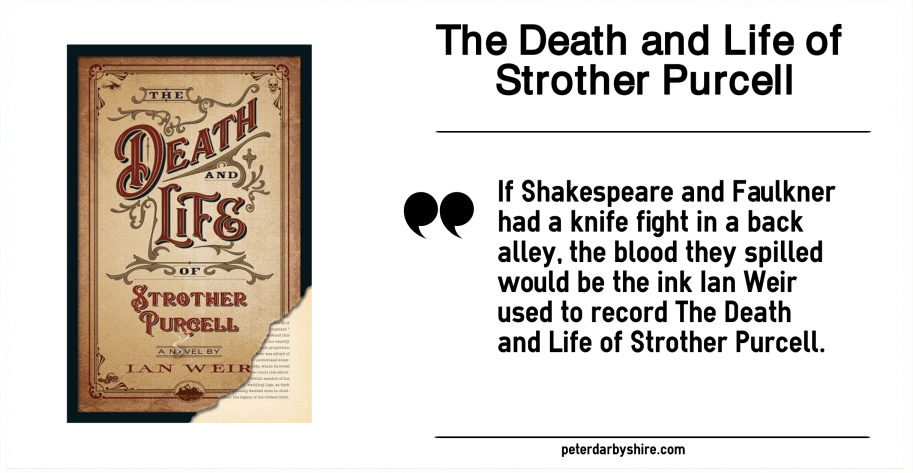
If Shakespeare and Faulkner had a knife fight in a back alley, the blood they spilled would be the ink Ian Weir used to record The Death and Life of Strother Purcell. The tale of a legendary gunman and his outlaw brother is as mythic as it is down and dirty, crossing years, borders and near every moral and ethical boundary imaginable as the estranged brothers head for a reckoning that is sure to be as apocalyptic as it is inevitable. It’s fit for those who like the westerns of Cormac McCarthy and Annie Proulx in equal measures: as literary as it is lurid, as epic as it is eerie. Picture John Wayne riding into a Greek tragedy and you’ll have a notion of the peculiar brilliance that is The Death and Life of Strother Purcell.
Jacket copy:
In 1876, the fabled lawman Strother Purcell disappears into a winter storm in the mountains of British Columbia, while hunting down his outlawed half-brother. Sixteen years later, the wreck of Purcell resurfaces – derelict and homeless – in a San Francisco jail cell. And a failed journalist named Barrington Weaver conceives a grand redemptive plan. He will write Purcell’s true-life story. All it requires is a final act…
What unfolds is an archetypal saga of obsession, lost love, treachery, and revenge. A deadpan revisionist Western, refracted through a Southern Gothic revenge tragedy, The Death and Life of Strother Purcell is a novel about two cursed brothers, a pair of eldritch orphans, the vexed nature of truth, and the yearnings of that treacherous sonofabitch the human heart.
Who says miracles don’t happen?

Do our apocalyptic times have you feeling down? Maybe you need a little miracle to take your mind off things. From now until the end times, aka the end of summer, Wolsak & Wynn is sharing for free my story “Casual Miracles” from my latest collection, Has the World Ended Yet? Free! (Batteries not included. Some sanity checks may be required.)
King of Tokyo: Or how I learned to stop worrying and love my extra head and poison quills

Do you like movies about giant monsters smashing puny cities and their even punier inhabitants? Do you like board games? Do you like the idea of snorting strange little green cubes for bizarre power-ups like extra heads and poison quills? Then you’ll love King of Tokyo.
Promo copy for the game:
Play mutant monsters, gigantic robots and other monstrous creatures, rampaging the city and vying for position as the one and only King of Tokyo!
Sounds like good, clean, silly fun? It is. I’ve played King of Tokyo many times and it’s become my go-to game (although Forbidden Island and Forbidden Desert are still close seconds). It’s fun, it’s quick and every game is different thanks to the card and dice mechanics. Best of all, it’s simple without sacrificing strategy and tactics. In fact, you have to think through a strategy for your monster based on the random dice rolls – and that strategy can change quickly as you move about Tokyo.
 The premise. You’re a horrible monster who wants to make Tokyo your own little sandbox of destruction and, well, destruction. That’s not a problem, given you’re a fearful creature such as the deranged Space Penguin, the malicious Cyber Kitty, the reptilian Gigazaur, the Godzilla-esque Mecha Dragon, the alienated Alienoid and the not-at-all-infringing-on-copyright-giant-gorilla The King. The problem is all the other monsters want to make Tokyo their own. The only choice is to fight it out.
The battleground is simple. A small board with a rendering of Tokyo in flames, and a red circle on the map to mark the home of the current King of Tokyo (plus another circle for Tokyo Bay for games with 5-6 players). The battle rules are also simple: roll six dice marked with various numbers and icons that allow you to attack, heal, earn energy cubes to buy special powers or collect victory points – first one to 20 wins! There’s a surprising amount of strategy involved in the dice rolling part of the game because you’re actually allowed three rolls. After the first roll of six dice you can reroll any number of them to build toward a goal for that turn – and the same goes for the third roll. So let’s say you’re badly wounded (all the monsters have limited health). You roll six dice and get three hearts, a 1 and two energy symbols. You keep the hearts and reroll the other dice and get another heart and two energy symbols again. Now you keep the four hearts, which is pretty good for a heal, and roll again because you’re pissed off about being wounded and don’t want to spend your time collecting energy. Two claws – great! You heal and wound your enemy!
The strategy can go any way you want. Maybe you want to collect energy cubes so you can buy cards that give you special powers – like the zombie costume that allows you to keep playing even after you’re dead (death normally results in a loss for you, but not always), or the wings card that allows you to escape Tokyo without taking damage.
What’s that? Escape Tokyo? But isn’t being king of Tokyo the point? Yes, but it’s not that easy. Some complicating factors: When you are in Tokyo, your attacks affect everyone outside of Tokyo. Yay – massive, wrecking damage! Also, when you’re in Tokyo, everyone’s attacks from outside of Tokyo affect you. Boo – massive, wrecking damage! On the plus side, you earn two victory points every turn you occupy Tokyo, so it doesn’t take many turns in the red circle to win the game. Victory is mine! On the other hand, you can’t heal when you’re in Tokyo. Death! Sweet, sweet death….
The games usually feature monsters stomping in and out of Tokyo, savaging their opponents and getting savaged, retreating to heal, then charging forward all over again. Thanks to the cards, every game is different – oh look, Space Penguin has an extra head and a robot suit while Mecha Dragon has poison spit and a giant brain….
 If you ever get bored, there are plenty of expansions – I have the Halloween pack for King of Tokyo, which features two new characters, Pumpkin Jack and Boogey Woogey, plus evolution cards and new costumes. I also have King of New York, which adds to the basic game by introducing buildings and army units to be smashed by the monsters – and six new monsters!
I’ve played King of Tokyo with adults and young adults, who like the game just fine. My life being what it is, though, I rarely get out of the house for fun so I end up playing with my sons, 8 and 3. The eight-year-old loves the idea of wrecking cities and blasting his dad to death. The three-year-old just wants to roar and smash things. We play special rules with him, where he is only allowed to attack and heal and forget the strategy stuff. That makes him a real force of destruction – just like in real life, but with fewer trips to the ER.
So if you’re looking for a new game, check out King of Tokyo. Destroying the world hasn’t been this much fun since that book I wrote.
Every story is a miracle, really
Oh my, I’m honoured to see my story “Casual Miracles” from Has the World Ended Yet? made the 2018 Sunburst Award longlist for Short Story Fiction.
The story is one of my favourites in the collection – and one of the last to be written. I was lounging in the bath one day, as writers do, reading some news story or another about Craigslist when I started thinking about what sort of crazy services people advertise online. That’s where I got the idea of “casual miracles” – miracles that don’t really change anything in the grand scheme of things. And now here we are.
Anyway, I’m honoured to be included in such an amazing group of writers! Go read them all now!
On the bookshelf: Certain Dark Things

What is there to say about Certain Dark Things, the vampire novel by Silvia Moreno-Garcia set in Mexico City that mixes up the entire cinematic, literary and mythic history of vampires with the narco conflicts of the Mexican drug wars, run through a noir filter with the thriller levels cranked up, to create her own dangerous species of vampire novel?
What is there to say other than read it?
If you like the end of the world, you’ll also love lost cosmonauts

I just recently discovered the work of Jeremy Geddes, which is so in synch with my latest book, Has the World Ended Yet?, that it could have been the cover artwork. (Although I do love the cover artwork it already has!) Geddes’ art feels like it’s invoking the same space as my stories “Has the World Ended Yet?” or “First Contacts” — particularly the latter story. (If you’ve read it, you’ll understand why.)
Anyway, I love these paintings and I wanted to share them.
If you like Geddes’ art, he has a store.
On the Bookshelf: Happinesswise by Jonathan Bennett

Happinesswise by Jonathan Bennett could just as easily have been called Intimatewise or Intimacywise or some such thing. While the poems are all over the map when it comes to style and subject matter, at their core they are glimpses into the secret lives we all carry within us.
The book opens with a series of poems called Palliative Care Reflective Portfolio, which yes, are about death, but in that are also about entire lives lived. The poems feature notes about end-of-life care and the mundane minutia of death, or at least of putting off death for a few more ragged heartbeats: “the machine drone, the urine sting, the sour C. diff smell, the pump throb, the infection control, latex-free signage.” But the clinical language of the palliative care experience are countered in the same poems with the beautiful, transcendent moments of life, the memories that actually make us what we are: “tinkling wind chimes, your still-beautiful clavicle” and “My son’s first steps – across the lichen at the lake.” In an interview, Bennett states these poems are inspired by his own experiences working in a hospital and reading doctors’ portfolios: “Somewhere in the fog of pain meds and held hands, of DNR’s and oncoming grief, people retell stories that have bound them to one another over the course of a lifetime. Or else they sit in silence and just know, together. Is this happiness? Is it the end of happiness? These are the things the poem pursues.”
While the Palliative Care Reflective Portfolio is not specifically about Bennett, other poems do provide more intimate glimpses into his life. The poems found in Neurotypical Sketches offer insights into Bennett’s relationship with his autistic son – and insights perhaps into his relationship with autism, or at least autism as he has experienced it. There’s a map drawn by his son, Thomas, and moment after moment of a life transformed by something ultimately unknowable:
“He asks: Do cyclops blink or wink?
We laugh and and I ask him to tell me
the riddle of Theseus’s ship again
because I can’t get enough of him
charting his way through a paradox.
And to hear him argue the case
for Bigfoot is to doubt everything
you thought was true in the universe.”
There are other examples of this intimacy throughout the book – the series Concession Line Signs uses signs in Bennett’s region for inspiration, and as a vegetarian I certainly found a connection with his poem “Vegetarians Use the Back Door.” But really, it’s one of those collections best read and not talked about too much, because its true power is in how you will find yourself in the poems. How are you doing, happinesswise?