Blog Archives
How D&D made me the writer I am
Roll a d20 for a creativity check.
Whenever I do interviews, the discussion often turns to Dungeons and Dragons. What sort of influence has D&D had on my writing? I suspect my answer to that is the same as many other authors: I wouldn’t be the writer I am without D&D.
I started writing around the same time I started playing D&D back in elementary school. (Basic rules!) I can no longer remember which came first, D&D or my writing, but it doesn’t matter. They are both equally important in the development of the imagination and those paths that led me to become a writer.
I’ve mainly been a GM (or DM if you’re old school), which means you’re dreaming up other worlds for the players to inhabit. More importantly, you’re dreaming up a compelling story for them. So there are a number of things you have to think about when running the adventure.
Worldbuilding
GMs and writers both need to create interesting worlds with enough detail to catch the imagination of the players/readers without bogging them down in unnecessary detail. Guiding players through countless worlds in D&D sessions has taught me what sort of details matter and what don’t and how to shape worlds to reflect the mood and atmosphere I want.
For instance, if I’m creating a D&D adventure where my players explore a set of ancient ruins in search of a lich that has been plaguing their realm, I’m going to populate those ruins with wraiths and other undead, crumbling tomes, accidental traps where floors of the ruins are collapsing, strange mists and haunting sounds, and so on.
That has taught me to do the same in my writing. My second Cross book, The Dead Hamlets, is about a Shakespearean ghost, and I worked hard to ensure every element of the book reflected that in some way. There are characters from the theatre, key moments take place on stages (real or fantastic), characters quote famous theatre lines, actual theatrical ghost legends are throughout and so on.
The Dead Hamlets is very different from the first Cross book, The Mona Lisa Sacrifice, where I really wanted to set up an alternate version of our contemporary world in which angels scheme behind the scenes and magic is hidden everywhere. In The Mona Lisa Sacrifice I researched different historical periods like the Great Depression and included references to Raymond Carver and modern and historical buildings like the Seattle library and the Gaudi church in Barcelona.
Of course, it’s worth mentioning that every GM and writer will have different priorities here. Some love worldbuilding that includes rational and comprehensive magic systems, genre rules and so forth, while others prefer things wilder and looser. I’m in the latter camp but it’s all a matter of preference.
Plot
Plot is just as important to D&D as it is to books and stories. I learned early that every game session needs to advance the story and the stakes for the players. If you’re just running around killing monsters and looting ruins, that gets old and boring very quickly. So each session sets up a goal for the players, an obstacle to that goal, and an outcome that advances the tale to the next session. It’s the same structure I use for chapters or even scenes. Goal, obstacle, resolution — the building blocks of any story.
(Of course I can’t help it if my players or characters don’t cooperate.)
Character development and emotional arcs
D&D players want their characters to grow and change — not only to become more powerful but to become fleshed out with dramatic stories and achievements. Players don’t simply want to do the same thing over and over. They want to evolve and have an emotional investment in this fictional character.
It’s the same thing for readers of fiction. They want to see the characters grow and develop — even if it doesn’t always end with positive outcomes. It’s become increasingly important to me to have characters that change, that develop over the course of the story in a way that readers recognize and care about.
This is something I had very much in mind in my fourth Cross novel, The Wonder Lands War. I could have simply written another tale of the immortal rogue Cross getting into trouble and saving the world, but I knew it was time for some big changes in Cross’s life after everything he had been through in the previous books. So the real focus of that book is about parts of his life and world ending, with his daughter’s death (second death, that is), the demise of the faerie court that have long been his companions and nemesis, and new relationships with the angels that he constantly seeks to kill. It’s a tale of how life happens to all of us, with inevitable change and some chapters coming to an end while others begin.
Collaborative storytelling
The idea of collaborative storytelling is particularly important for me, and it’s where D&D has really had an influence. I’m not one to play the game strictly by the rules or to follow adventure scripts like bibles. Instead, I tend to work with a general outline of ideas and continuously adapt it as the game evolves and my players do wonderful and crazy things. And sometimes wonderfully crazy things! I find the true magic of a D&D session lies in the moments that can’t be scripted ahead of time, when the players come up with something on the spot that even they hadn’t planned which changes the whole arc of the game. To me, the story we create together is the most important of the game, which is why I don’t mind altering the rules or the planned adventure to accommodate that story. (I’m definitely not a rules lawyer.)
Take, for instance, a recent campaign I ran where my players were intent on throwing a Saddle of the Cavalier upon every tough creature they encountered so they could ride it into battle. (A Saddle of the Cavalier prevents riders from being dismounted against their will.) They ended up battling what they thought was a beholder in a lich’s mansion and charmed then saddled it. However, they didn’t know that the beholder was actually a dream version of a Death Tyrant, which can’t be charmed. I could have played by the rules and had them fail the charm attempt. But in the moment I thought it was much more interesting to have them saddle up a Death Tyrant and ride it into combat against their enemies. I was right and we created an awesome and very memorable session together.
I try to keep that spirit of collaboration in mind in my own writing. I often present mini-scenarios in my books or stories that hint at tales not actually covered by the work at hand: interesting asides, nuggets of back story, that kind of thing. Take for instance, the idea I put out in The Mona Lisa Sacrifice of the Gaudi church being in fact a tomb meant to imprison something. Imprison what exactly? Well, that’s up to the reader to decide.
Some may consider these moments story threads that I’ve failed to tie together. But I see them as imagination prompts for the reader to create their own tales. Ideally, they’ll take the story hint I’ve inserted and create a whole other story with it. Now imagine that becoming a different story with each reader. So many tales that spring out of the original story! Just like so many different tales emerge out of D&D adventures. There’s a reason so many writers and D&D players!
I could go on about this forever, but it’s time for my D&D session!
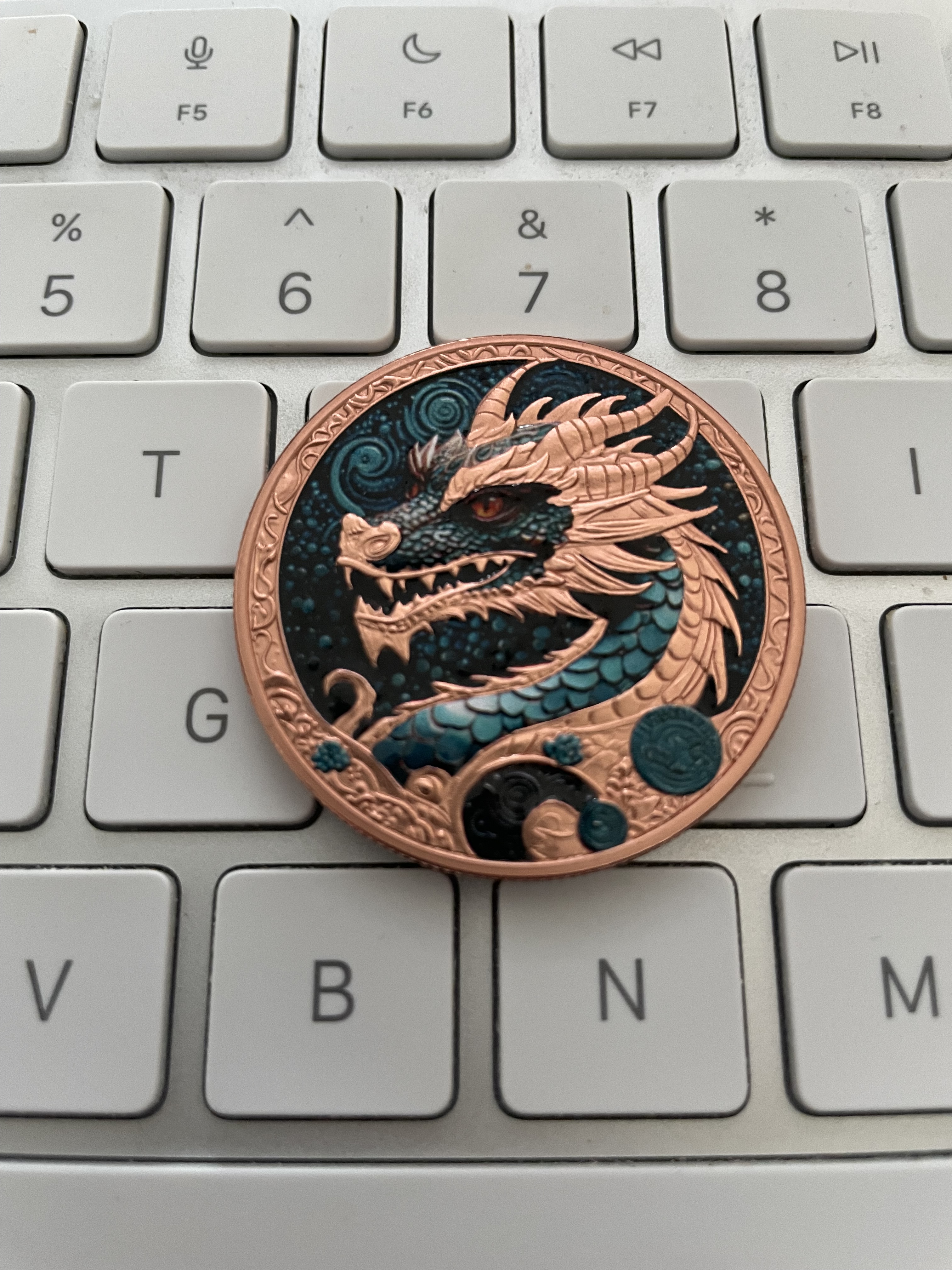
(The coin in the image is a gift from the wonderful fantasy writer Sebastien de Castell, who also happens to be a D&D player.)