Category Archives: Uncategorized
The future's so bright

Mindfeed: What will the robots build to make their lives better?
Here’s what I’ve been reading of late:
– Parasites help our immune system. The enemy of my enemy….
– Amazing video of a man in a wingsuit. I don’t know how he can fly with balls that big.
– Assassin bugs dress in bodies to avoid attacks from jumping spiders. I’ve said it before, and I’ll say it again: Nature is hell.
– Google Earth as a “stratigraphy of moments piling up out of time”
– Please stop the forced fun at work
– Captchas are now ads. I hope an assassin bug kills whoever is responsible for this and wears the corpse.
– Deliver me to hell: Choose your own adventure zombie pizza delivery ad (YouTube)

The Warhol Gang: It's all true
One of my favourite scenes in The Warhol Gang — yes, I have favourite scenes in my own book — is a car chase in an underground highway system that runs beneath the mall. Well, technically, it’s part of the mall. Anyway, our hapless hero Trotsky is driving a stolen delivery truck and relying on the GPS to direct them to safety — the modern man’s prayer. Instead, the GPS drives them into disaster — the modern man’s god. I worried I might be taking liberties with the accuracy of technology here, but a couple of recent stories about GPS disasters reassure me that I’m writing nonfiction.
Remember, it could happen to you.
E-books — even better than the real thing?
I was previewing some books today on Kobo when I realized how much I’ve changed my book-buying habits over the last year. For the past five or six years I’ve maintained more or less a 50-50 split between buying books in stores or buying them online (at first through Amazon but then Chapters when I started to worry about Amazon’s business practices). I’ve generally tried to buy in stores first and have then gone online when I couldn’t find the book, but I haven’t been religious about it.
Since I started using Kobo, however, I’ve shifted my book buying to e-books without even really noticing I was doing it. I estimate about 70 per cent of the books I buy now are e-books, almost all of them from Kobo. Most of the physical books I purchase are through Chapters online, and generally that’s because I can’t find an e-version. I probably haven’t bought more than three or four books in an actual store this year.
There are all sorts of arguments for choosing the physical book over the e-book — design and the physical book as fetish object being the main ones — just as there are good arguments for visiting physical bookstores, such as supporting the cultural ecology of a community.
There are also valid arguments for choosing e-books over physical copies. For me, a major one is ease of use. I love being able to read and bookmark a book on multiple devices, so I can pick up where I left on an any computer I happen to be at. There are also the space savings — I just get overwhelmed by my physical books sometimes and have to clear them out, but you don’t have to worry about that with a digital library. They’re probably also more environmentally friendly, although stand-alone e-reader devices may skew that equation. I don’t use stand-alone readers, though, so I’m probably greener than I used to be in my reading habits. And, of course, there is the issue of availability. I’m rarely able to find the books I want in physical bookstores for various reasons — they’re not mass market enough, they’re older books I’ve discovered through word of mouth, they’re poetry. And let’s face it, the design of e-books will improve, and in the future e-books will likely be more interesting than their print counterparts, not less. Check out the Alice in Wonderland app for a hint of things to come.
Perhaps the main reason I’ve switched to e-books is because most of my purchases are spontaneous. I’ve bought a poetry book while rocking my baby, an absurdist yet touching take on job cover letters when I’ve been down at work, a non-fiction war book while working out on the exercise cycle. No more wish lists and/or scouring bookstores to find a print copy. Now I read about something, check it out on Kobo almost immediately, and decide right then and there to buy it or not. So I’ve usually made a purchasing decision within minutes of reading a review, blog post, interview, etc. (OK, if baby’s crying, I add the book preview to my library and come back later to make up my mind.)
I suspect I may be buying more books now, which is good news for writers and publishers alike. I’m going to see if I can figure out the differences between years when I tally up my receipts at tax time.
I wonder how many other people are experiencing a similar transformation in their book-buying habits. I suspect it’s a large number, and it’s going to increase as e-books are now — finally — becoming widely accepted and read. I was at a conference recently where many of the attendees were enthusiastic about e-books and the possibility of shaking up the publishing industry — and the very ways we read. The only people pushing back seemed to be those working in publishing, who obviously had personal interests at stake. There were also some publishing types who saw it as a way to improve their business by allowing them to produce books that might not have made financial sense in print form.
Anyway, I’m just thinking out loud here, not trying to write some manifesto about how e-books are better. I’m curious about other people’s experiences with book buying. Any stories to share?
If I had it all to do again….
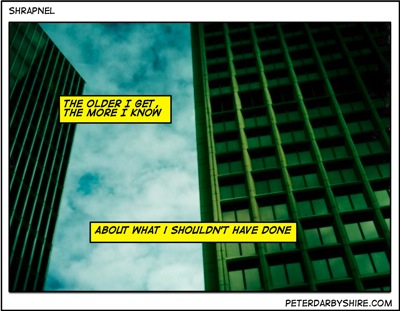
buy postcard | buy postcard with added lit
If I had it all to do again, I’d do it all again, only this time I’d try not to get caught.
First contact (final contact)
We sent messages to the aliens, to see if there were aliens. We filled the void of space with television — Nazi rallies and I Love Lucy. We filled the silence with radio signals. We launched spacecraft in search of the heavens, and we filled them with our memories, or at least what we wanted our memories to be. Gold records. Whale songs. Bach and da Vinci. Greetings from people long dead. We beamed fractals and computer programs in every direction. We called out in our own languages, in the languages of mathematics, in the languages of colours. We called out in all the frequencies we could find.
We said over and over, we are here. Come find us. Please.
And we waited for an answer. We listened for radio signals in response. We filled our deserts with Seti arrays to catch whispers from the stars. We scanned the stars and the spaces in between for laser beacons, for the slightest flicker of light that signified something. Anything. We created optical telescopes and spectrometers that had no other use than to study the atmosphere of other planets, searching for some trick of life. We waited for an answer.
It came, as answers usually do, in destruction. An asteroid storm of ice chunks that destroyed most of our satellites at once. Debris tore apart the space station and one of the secret military spacecraft. They made more debris. Our astronauts screamed their own messages into the vacuum. Our sky was ruin and blood.
But then we saw the pattern in the constellations of wreckage. The order forming out of the chaos. Signal emerging out of noise. A message was hidden in their decaying orbits. Our scientists and code breakers worked for lifetimes trying to decipher it, before the signs burned up in the fires of our atmosphere. And then we finally understood it. A new form of binary. A binary of destruction expressed in the remains of our spacecraft and the quantum emptiness they moved through. We didn’t know where the message had come from. We didn’t know what it meant. All we knew is what it said.
we are on our way to answer your prayers
Why I use Kobo
I’ve tried out a few e-reader services, and while I like Apple’s iBooks the best when it comes to design, I’ve settled on Kobo as my primary reader. Why? It’s partially the ability to read on any device (seriously, Apple? No laptop option?), but mainly it has to do with Kobo’s approach to business and their respect for readers. See, for an example, the eReaders Bill of Rights.
First contact (4)
We sent messages to the aliens, to see if there were aliens. We filled the void of space with television — Nazi rallies and I Love Lucy. We filled the silence with radio signals. We launched spacecraft in search of the heavens, and we filled them with our memories, or at least what we wanted our memories to be. Gold records. Whale songs. Bach and da Vinci. Greetings from people long dead. We beamed fractals and computer programs in every direction. We called out in our own languages, in the languages of mathematics, in the languages of colours. We called out in all the frequencies we could find.
We said over and over, we are here. Come find us. Please.
And we waited for an answer. We listened for radio signals in response. We filled our deserts with Seti arrays to catch whispers from the stars. We scanned the stars and the spaces in between for laser beacons, for the slightest flicker of light that signified something. Anything. We created optical telescopes and spectrometers that had no other use than to study the atmosphere of other planets, searching for some trick of life. We waited for an answer.
It came, as answers usually do, in destruction. An asteroid storm of ice chunks that destroyed most of our satellites at once. Debris tore apart the space station and one of the secret military spacecraft. They made more debris. Our astronauts screamed their own messages into the vacuum. Our sky was ruin and blood.
But then we saw the pattern in the constellations of wreckage. The order forming out of the chaos. Signal emerging out of noise. A message was hidden in their decaying orbits. Our scientists and code breakers worked for lifetimes trying to decipher it, before the signs burned up in the fires of our atmosphere. And then we finally understood it. A new form of binary. A binary of destruction expressed in the remains of our spacecraft and the quantum emptiness they moved through. We didn’t know where the message had come from. We didn’t know what it meant. All we knew is what it said.
we were like you once
Mindfeed: The medium is the Marianas Trench
Here’s a few of the things I’ve been browsing on the web this week when I should have been working.
– The Science Tattoo Emporium. I like this site almost as much as Contrariwise: Literary Tattoos.
– The mystery of Challenger Deep. This article about the sequel to Avatar led me to watch this video documentary about how solving the mysteries of Challenger Deep led scientists to understood how plate tectonics work. Fascinating stuff.
– Geometric sociology: BLDGBLOG+Christoph Gielen (+Pynchon) = a study of the shapes our inhabited spaces make
– Holy f… Woman cut in half to remove her cancer. Great story, but, ah, I’m squirming.
– The Erotic Monster Manual. Yep, I looked at every entry.
– 13,000 satellites orbit the earth. Who is watching the watchers? Google.
– The guerilla war against guerilla advertising. Now if only they could do something about spam followers.





 peter darbyshire