Category Archives: Uncategorized
How to publish on Kindle
Since I posted about publishing the author’s cut of my first book, Please, on Kindle, I’ve had quite a few messages asking me how I did it. Seems there are a lot of other writers interested in the same thing. So here’s a quick guide for you. I’ll post things in greater detail if there’s interest. If you have any questions, just ask them in the comments.
1) First, make sure you own the e-rights to the book or story or whatever. The rights for Please reverted back to me a little while ago, and I didn’t do anything with them because I was thinking about finding another print publisher in the future. But then I stumbled across a few blogs detailing people’s experiences with self-pubbing on Kindle, and I thought I’d give it a try. But you can’t do it if you’ve sold the rights to your publisher. Hopefully, they’re already publishing it for you on Kindle if they’ve got the rights.
2) Make sure you have an Amazon account. You’ll need this to access the Kindle Direct Publishing dashboard. If you buy books online, you probably have an Amazon account already.
3) Find a cover image. I assumed that when I got back the rights for Please that rights to the cover art weren’t included. So I bought the cover photo for the Kindle edition from istockphoto, a Canadian company. The image was one of their more expensive ones — I think it cost me around $80 — but I felt it was perfect for the book. You’ll want a simple, strong image. The Kindle covers are almost always viewed as thumbnails, so you want something clear and bold. I added the title and author name in Pages, then exported the whole thing as a JPG. Simple. I probably could have done something fancier with the text, but I like the simplicity of it. This process should work just as well in Word.
4) Get an ISBN for the ebook. You can do this for free in Canada through the Canadian ISBN Service System. You cannot use your print edition ISBN for the ebook.
5) Now go to the Kindle Direct Publishing page for everything else you need to know:
In short, what you need to do is strip your document of all but the most basic formatting — take out the tabs and indents, make the doc single spaced, things like that. The reason is it’s going to get converted into an HMTL file. The simpler your file, the smoother this will go. You can get as fancy as you like in HTML, but the Kindle has its own style settings, so there’s not much point.
If you’re not comfortable doing this, there are services you can use for reasonable fees, or there’s a pretty easy walk-through guide at the free service Smashwords. But it’s not that hard, although there’s an inevitable trial-and-error period.
Once you’ve done the reformatting and conversion to HTML, you’ll either use Mobipocket Creator to convert it to a Kindle file if you’re a Windows user or Calibre if you’re a Mac user. Both are free downloads.
Then download the Kindle previewer to test it out. This is important. I didn’t know there was a downloadable previewer at first, so I was using the previewer on the KDP website, which is fine for a short story but not a great way to proof a book over a few days.
6) When you have a file that works, upload it to Kindle, set your world rights and your price, enter your ISBN, and your descriptive copy, and hit Publish. Wait a day or two for the file to become live, and then start compulsively checking your sales.
Note that the writers making serious money at this tend to be in the mystery, paranormal or fantasy genres. There’s not a lot of “literary fiction” writers getting rich or even sci-fi ones from what I can tell. So why don’t you be the first?
Get the author's cut of Please for under a dollar!

I’ve put together a special “author’s cut” edition of my first book, Please, for the Kindle, and Amazon has temporarily discounted it to 99 cents. Get it while supplies last! (I have no idea how long it will stay at this price.)
It includes a behind-the-scenes look at writing the book and some tweaks to the copy. It also has a new cover. Shiny!
I’ll have versions available for other e-readers shortly, but they won’t be 99 cents. Just saying.
Murder is a family business

Last year I remember reading some updates of writer friends of mine with children and wondering how they did it. All those posts about getting in a half hour of writing here or there while the child was asleep/distracted/caged. I thought “There’s no way I could write like that.”
Now I have a not-so-little boy about to turn 11 months old, who really wants to race me up the stairs and bang his head on the floor while practising MMA moves on his teddy bear, and that’s exactly how I write. When I can, however I can.
Take today, for instance. My wife managed to slip out of the house while I wasn’t looking, no doubt to some spa appointment where she leisurely made her way through the latest New Yorker while attendants hand-fed her peeled grapes. Meanwhile, I spent the day at home with Edmund Hillary Jr., who was determined to climb the Everest steps solo, without the help of his overgrown Sherpa. The only solution was to stick him in the high chair and feed him lima beans and other tasty treats with one hand while typing out a murder scene with the other. And so it came to happen that a stray piece of avocado inspired a memorable moment with an eyeball in the new book….
They should just invent a tool called stabby, slicy thing
Today’s writing session involved a little research with a friend. I’ll protect his identity by calling him Scotty.
Me: Hey, your wife used to be a paramedic, right?
Scotty: This isn’t going to be another one of those fetish conversations, is it?
Me: No, no, not this time. I just need to know what kind of stabby things you can find in the back of an ambulance.
Scotty: I think they have all sorts of… stabby things.
Me: And slicy things. I need something that can stab and slice.
Scotty: You want to know this why?
Me: I need to kill someone tomorrow, and it has to be something taken from the back of an ambulance.
Scotty: When the police come talk to me, I’m denying we ever had this conversation.
Me: It’s research. For the new book.
Scotty: Uh-huh.
Me: Whatever the stabby, slicy thing is, it can’t be scissors. I think the paramedics carry those on their belts and the paramedics aren’t with the ambulance.
Scotty: What happened to the paramedics?
Me: Oh, they’re looking for the ambulance.
Scotty: I imagine they are.
New cover for The Warhol Gang paperback

The paperback edition of The Warhol Gang is now listed at Amazon.ca, and I like the new cover design, especially the hint of Elmore Leonard!
100 pages of corpses!
Today I hit the 100-page mark of my new novel, The Apocalypse Corpse. Or, if you’re more of a word-count person, just under 30,000 words.
Going by my outline, that’s roughly one-third of the book done. Of the first draft anyway. And no outline ever survives contact with the midnight Brilliant Idea That Changes Everything But I Can’t Exactly Recall In The Morning.
It’s an interesting experience writing this one. It’s my fifth book, and I’ve really come to appreciate the saying “you only ever learn how to write the book you’re writing.” (Yeah, I know, if you look at your bookshelf you’ll only see two books of mine. But the agent’s got another new manuscript that she’s about to give me notes on, and I have the first draft done of a sequel to that book already done. So the next couple of years should be busy ones for me.)
For each of my first two books, I had a very different approach. With Please, I wrote the episodes in no particular order, as the ideas came to me. I polished them as much as possible before moving on to the next ones. When I had a full book’s worth of episodes, I then organized them into a loose narrative (and loose narrative was all I wanted for the structure of that book) to give them a timeframe and an emotional storyline. Then I polished them some more. Then my editor gave me her notes and I reorganized and polished some more. Shiny!
With The Warhol Gang, I tried to write in the same episodic, chapter-like structure as Please and quickly slammed into a roadblock. I’d get a few pages in, hit some plot point that I hadn’t worked out yet, and completely stall. I couldn’t do it. That kind of structure felt wrong for the book — it felt more like containment than foundation. I had to find another way to write the book. I flailed around for a few months (OK, years) until I finally found something that worked for me: focusing the book on scenes rather than episodes/chapters. It may seem simple, but try telling your editor that you’re not going to use chapters or stories or any of the usual framework of a book. Luckily, I’ve been blessed with both good and patient editors.
Breaking the book down into scenes was incredibly liberating, in no small part because it allowed me to jump past parts that gave me problems. Sometimes skipping a scene and writing the next few allowed me to realize what I needed to go back and write the omitted sections. And I went back and rewrote a lot, perfecting everything I’d done earlier. It went something like this: Write 50 pages until I ran out of ideas, go back and edit those 50 pages and get the ideas to write another 30 pages. Go back and rewrite those 80 pages and get the ideas to write another 20 pages…. Maybe I could have done the same thing with a traditional narrative structure of chapters — only I couldn’t when I tried. Hey, sometimes writing is all about tricking yourself.
And then, of course, once the book was almost in its final edits stage, I decided to change the narrative POV from third person to first….
With The Apocalypse Corpse, I wasn’t sure how to approach it. There are a lot of threads in the book — the narrator is trying to answer some pretty significant questions about his identity while racing to figure out the mystery of the Apocalypse Corpse if he wants to survive, and this is set in the cultural funhouse of the 21st century, populated with a cast of characters that make my other books look like Jack Chick comics. I knew I had to have a pretty strong, clear plot line to hold it together. Plus, I’ve got a 10-month-old baby, so there are plenty of distractions and I’m usually in a state of mind somewhere in between a zombie and, well, someone’s who’s been bitten by a zombie. So I wrote the most structured outline I’ve ever written. Usually my outlines tend to be overlapping balloons of emotions rather than action, but this outline was one long arrow of action.
Which meant when I sat down and started to write, it just flowed out of me. I actually have trouble stopping my writing at the end of the day because it’s so clear to me what comes next. The writing is perhaps a little rougher than it would normally be at the 100-page mark of my process, but I’m at that mark a lot quicker than usual. Which means there will plenty of time to go back after it’s done and polish away.
I hope the next 100 pages come as easily. If they do, you won’t have such a long wait for this book as you did for The Warhol Gang. And this is the most fun I’ve had writing a book yet. Let’s hope it stays that way.
Oh, if you’re interested in what happens at the 100-page mark, it involves a funeral home, a stolen ambulance, and a rather unusual black market.
And yes, I know I haven’t talked about the writing process of those other two books the agent is looking at. That’s a whole other blog post….
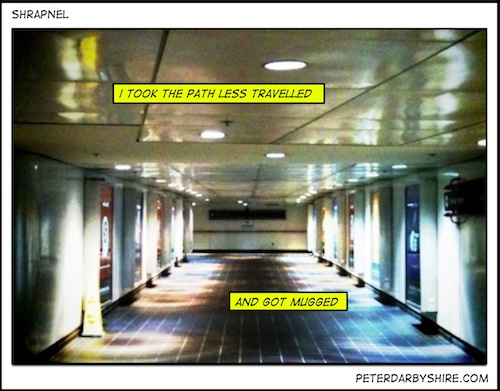
When in doubt, cut
Another productive few days. I’ve managed to make it to the 70-page mark in the first draft of The Apocalypse Corpse. It’s amazing what you can get done when The Child naps.
I’m not stopping to polish anything — I’ll do that later — but I’m happy with the way it’s coming together so far. I still don’t want to give away too much, but I will tell you the narrator (yes, it’s another first-person extravaganza) is a repo man with amnesia.
Today’s research had me looking at distributor websites for coroner equipment. Dear gods, why do they have ladles? Some people have scary jobs….
OK, off for a stiff drink now.
And so it begins. Again.
I’ve started writing a new novel, The Apocalypse Corpse. I’ve written about 50 pages since the beginning of the new year, which is lightning speed for me. (The last book took years. And years.) But I plotted this one out ahead of time, rather than during the writing, so hopefully that’ll make a difference.
I’ll let you know what it’s about when I have more written. Don’t want to jinx myself by talking about it too much now. But I will reveal that my research this week took me back to the Kennedy assassination and up to the Fallen Astronaut on the moon. In case you think it’s a historical novel, though — by me? Please! — it also visits the Gulf War, waves in a friendly manner at the subprime crisis and gets drunk with Baudrillard. Hey, I’d want to read it!
More to come in the next few months.





 peter darbyshire