Category Archives: Uncategorized
Comedians talking funny
Here’s an interesting conversation between comedians Ricky Gervais, Jerry Seinfeld, Chris Rock and Louis CK about the theory/craft of stand-up comedy. Lessons to be learned for all artists. (First of four parts, click the related links when the video ends to continue.)
Canada's Indigo Books & Music changes returns policy
Canada’s largest bookstore chain, Indigo, is introducing some dramatic changes to its returns policy for publishers. According to a Quill and Quire report, Indigo plans to evaluate how books are selling after only 45 days and return slow sellers to publishers shortly thereafter. On top of that, they’re cutting shelf space for books to roll out more lifestyle products — no doubt more picture frames and gift cards and that sort of thing. So that means a book has to sell like, well, a bestseller in that first month and a half after release or it’s off to the glue factory. And forget about backlists for all but the most commercially successful writers — there just won’t be any room in the bookstores for that kind of luxury.
Publishers are understandably upset with the impending changes, but I can’t really blame Indigo. The marketplace is changing as ebooks gain in popularity, and Indigo is just trying to survive. There’s no future in remaining dedicated to print books, so Indigo is diversifying into products that earn more money per square foot. It’s just business.
Publishers need to make the same sort of tough changes and transform their business models. It’s time for them to break up with bookstores before they get dumped. Sure, bookstores have traditionally been publishers’ real customers, and most of their marketing and promotions have been directed at the retail outlets. But they need to get out of the distribution mindset and start building relationships with readers, not sales reps and store managers. They need to think in terms of community, not copies shipped and returned. Take the recent initiative of Angry Robot Books in the UK, for instance, which reached out directly to readers and offered them a package discount if they bought the entire season’s list of new books — ebooks, that is. Angry Robot’s offer is similar to Baen’s webscriptions service, another new publishing model that focuses on digital rather than print. (Angry Robot also sells other products, such as iPod cases and T-shirts — lifestyle objects that support the cultural brand rather than replace it.)
These publishers are finding success in forming direct relationships with readers, and all publishers need to follow similar digital initiatives. It’s a shift that’s happening in other industries — I work in the media and most newspapers have adopted a “digital first” position, openly acknowledging the days of print are numbered. Publishers need to do the same. Print books will be around for some time yet, but they’re obviously on their way to becoming a niche product for bookstores. Bookstores should become a niche customer for publishers, and they should focus all their efforts on reaching the customers that will matter in the future: the readers.
Ebooks are an "incredible, democratic new medium"
Vancouver alt weekly The Georgia Straight interviews me and a few other publishing and literary types about why genre fiction does so well in ebook form. OK, it does well in print form too. But I think it does even better with ebooks.
Darbyshire noted that the romance industry has done for years what the electronic market has only now pushed other authors and publishers to start addressing. Romance wisely cuts out industry gatekeepers and focuses heavily on readers.
“The romance industry has always done a very good job of reaching out to the readers [as] opposed to the bookstores, which is what [traditional] publishers normally do,” he said, on the phone from his home in Langley.
I will survive… precious….
I rather enjoyed this version of the song “I Will Survive” performed by Mythbusters’ Adam Savage, egged on by Neil Gaiman. #nerdgasm.
A quantum riot
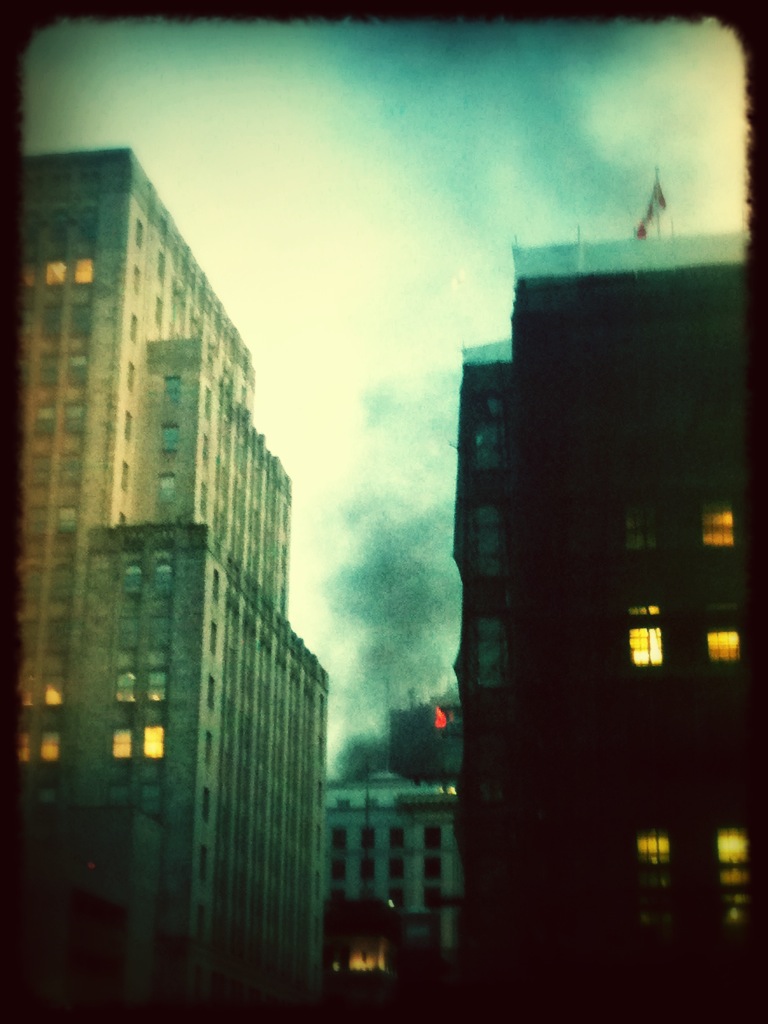
In my night job, I work as a news editor for the Province newspaper in Vancouver. News in Vancouver for the last few months has meant Canucks hockey coverage — until the hockey season finally ended with a Canucks loss in the Stanley Cup, and Vancouver’s second favourite sport, rioting, began. My newsroom is only a few blocks away from the riot zone, and I wasn’t surprised to see smoke rising into the sky moments after the game ended.
But I was surprised at what happened next: a riot that seemed to be less about violence and fan frustration — although there was plenty of that — and more about a celebration of, well, the riot itself. It was a spectacle that fed itself, or perhaps was fed by social media and the proliferation of smart phones. People rushed to broadcast the riot and thus swelled the numbers of the rioters, and encouraged the more violent and destructive members of the crowd to engage in ever more outrageous — and spectacular — acts. The whole time, I watched the riot trace its path across the skyline of the city in smoke signals, scanned the panicked tweets and Facebook messages flooding my feeds and, of course, watched it live on television even as it was happening outside.
The day after, I tried to make sense of events, like so many others around the city and even around the world. But it’s difficult. As Robert J. Wiersema tweeted at me, “Sometimes it’s like we live in Warhol Gang world.” And I was struck by some of the similarities between the riot and what I’d predicted in my novel The Warhol Gang. I also thought fellow writer Timothy Taylor had touched on some of the same issues in his latest novel, The Blue Light Project, about a city/society gone mad in a different way. We decided to have a conversation about the riot, to see if we could better understand it, and the National Post was kind enough to post the discussion online. An excerpt:
Peter Darbyshire: I’m not surprised many of the perpetrators have been identified so quickly. When you watch some of the videos, everyone has a camera and is filming the scene. It’s the most authentic iPhone ad I’ve ever seen. It’s almost like you couldn’t participate in the riot if you didn’t have a smartphone — it was your key into the fan/riot zone. When I was watching events in the newsroom as they were unfolding, though, I was struck by how many people were willing to perform crimes in front of all the cameras. I know there’s a bit of de-individuation that takes place during such events, where you subsume your identity to that of the mob and do things you wouldn’t normally do, but this seemed to move into a new territory. Everyone wanted to pose in front of the burning cars and flash their devil horns, or flash their breasts as some women did, or kiss like that couple on the ground (likely staged, I think). In some ways, this riot more theatrical than others because of the presence of all the phones. The riot itself was changed by the act of observation — a quantum riot? — and seemed to turn carnivalesque. It was like this weird mix of Mardi Gras and Burning Man and UFC. Like the riot was a black hole that sucked in all other forms of social disruption and spat them out again in a jumbled mess. Was this the first real 21st century riot in Canada?
It’s funny you mention Debord. I was thinking about Baurdrillard as events were starting to unfold. In my night job I’m a news editor at the Province and I was in the newsroom at the time, a few blocks away from the scene. We knew something was going to happen because 100,000 people in the downtown core is going to be an event and spectacle of some sort. We just didn’t know what kind. Then the tweets started flowing about burning cars and people started calling in tips. You have to try to filter these in a newsroom because the first news reports you receive are almost always simulacrums, if you will, of what’s really going on. Then we saw the smoke rising between the buildings and we knew something really was going on. But what? We received multiple reports from different callers about Canucks fans throwing a Bruins fan off the viaduct. We received multiple calls of a dead cop. And so on. We were trying to report the news, but the news that was being fed to us wasn’t real, even though people obviously believed what they were telling us. The whole event was hyperreal for everyone involved, including the media. I think that’s what maybe led to people rushing to join the riot rather than leave it. Something historical was obviously happening and people wanted to witness and understand it. And participate in it, of course. One of the moments that stays with me is a reporter interviewing people on video about why they’re rioting and a man holds up his bleeding hand, as if that is justification itself. Look, I have the mark of history on me.
Timothy Taylor: My take on both the mimetic power of the crowd and the impulse to photograph and pose link back to Debord. When those who manufacture “spectacle” are the most celebrated people in our culture (e.g. actors and athletes), you can expect the aspirations of individuals to quickly fall into line, where every person takes spectacle-creation to be the highest possible aim. Facilitate this tendency with social media, and you arrive the phenomenon of people posing in front of burning cars or taking pictures of themselves smashing windows at the Bay. They’re making secondary use of the spectacle — feeding it into FB and Twitter — in order to advance their own position as creators of spectacle.
What’s troubling about all this, aside from the property damage, is the speed with which the whole thing unrolled. Some broader disindividuation at work in our culture is at work here. When the cultural values prevail as I describe above, that is, when all people are in pursuit of the same objective — which I posit to be the status to which spectacle creation attends — then all people are likewise in competition. Competition which leads to envy which leads to rivalry which leads to escalation and violence.
In this sense you could see the crowd turn into a melee that was at once the work of a single organism — the beast composed of surrendered individuals — as well as that of competing individuals, each one fighting for a piece of the main action which is profile, recognition, status, renown.

More popular than Dostoyevsky

The Warhol Gang has had a nice surge in sales since the recent release of the paperback version, and it cracked Amazon’s top 100 list for literary fiction. It was at #54 last I looked — narrowly slipping past Crime and Punishment! If it cracks the top 50, I’m going to something crazy to celebrate. Like maybe go outside.




 peter darbyshire